

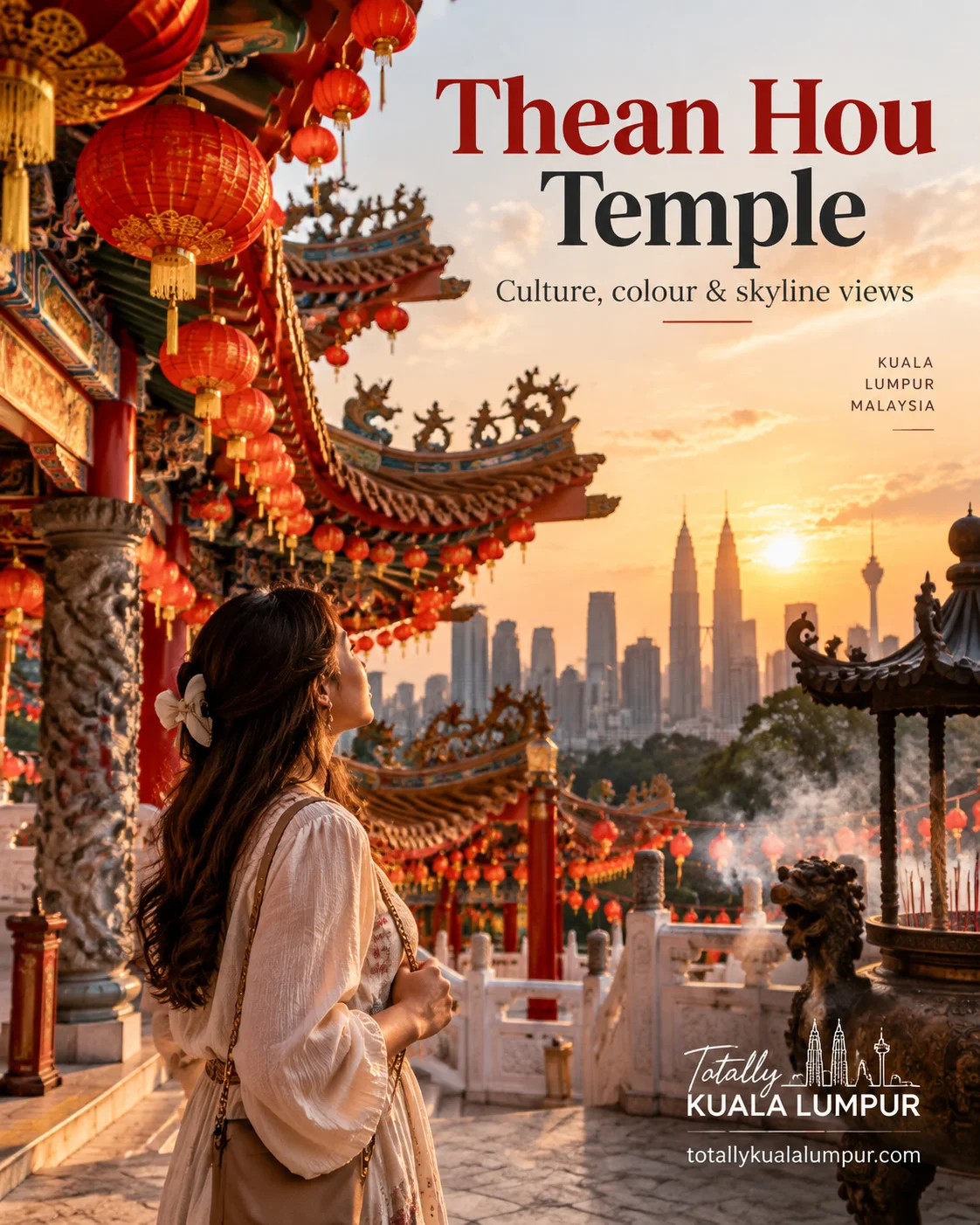
Why Thean Hou is worth the detour
Thean Hou Temple sits above Jalan Syed Putra on Robson Heights, south of Kuala Lumpur's main tourist core. Tourism Malaysia describes it as a six-tiered Chinese temple with golden-roofed pagodas, lanterns and three principal deity statues, while the Selangor & Federal Territory Hainan Association — the organisation behind the complex — publishes current shrine information and events.
The reason to come is not just size. The temple combines active worship, Hainanese community history, decorative Chinese architecture and elevated city views in one place. It is photogenic, but it makes more sense when you understand that the courtyards and halls are used for prayer, festivals, marriage registration and community activities throughout the year.
Current opening hours
The temple's current official Hainan Association site lists the shrine as open from 8:00 AM to 8:00 PM Monday to Sunday, including public holidays. Office and marriage-registration hours are different, so do not confuse administrative opening times with shrine access.
Festival periods can change the normal visitor experience even when the shrine remains open. Check the Hainan Association's current notices before a major Chinese festival because event timetables, crowds, ceremonies and traffic arrangements can all affect your visit.
Treat the official Hainan Association site as the source for current shrine hours and festival notices. Third-party guides often repeat old opening times without distinguishing the shrine from the office.
Who is Thean Hou?
The temple is associated above all with Thean Hou, the Queen of Heaven and sea goddess widely known as Mazu, a major figure in Chinese coastal and maritime religious traditions. Tourism Malaysia notes three majestic deity statues within the temple, with Thean Hou as the principal deity.
You do not need to know the theology in detail to visit respectfully. The important point is that this is a functioning place of worship. Visitors are welcome to observe the architecture and ritual environment, but prayer areas are not sets built for photography.
Hainanese roots in Kuala Lumpur
The temple is closely tied to the Selangor & Federal Territory Hainan Association, reflecting the role of Hainanese migration and community institutions in Kuala Lumpur's Chinese history. That makes Thean Hou more than a generic “Chinese temple”: it is part of a specific community network that continues to organise religious, cultural and social activities.
If you are exploring Kuala Lumpur's multicultural heritage, pair this with Chinatown or the city's older temples rather than treating all Chinese religious sites as interchangeable. Architecture, patron communities, deities and urban setting differ substantially.
The architecture: look up before you look out
The temple's visual impact comes from layered roofs, upturned eaves, red columns, ornamental ridgelines, lanterns and repeating courtyard geometry. Tourism Malaysia highlights the golden-roofed pagodas, while the six-tiered hilltop structure creates changing views as you move between levels.
Spend time looking at roof details and brackets rather than rushing to the skyline edge. The architecture is designed to frame movement through the complex, with threshold after threshold leading toward worship spaces and elevated terraces.
The main prayer hall
The main hall is the spiritual centre of the visit. Move quietly, give worshippers space, and avoid stepping into the middle of a ritual simply to get a symmetrical photograph. Incense, offerings and prayer activity may be more intense on festival days, first and fifteenth lunar-calendar observances, or other auspicious dates.
If you are unsure whether photography is appropriate in a particular area, follow posted signs and staff directions. Permission in an open courtyard does not automatically mean every altar or ceremony should be photographed close-up.
Lanterns and festival decoration
Thean Hou is especially famous visually during Chinese New Year, when lanterns and community events can transform the complex. In 2026, Kuala Lumpur City Hall publicised Chinese New Year activity at Thean Hou Temple over an extended festival period, illustrating how significantly the site can change during major celebrations.
Festival visits are memorable but not calm. Expect more visitors, worshippers, event infrastructure and traffic. If your priority is architecture and quiet observation, choose an ordinary weekday morning. If your priority is atmosphere, a festival period can be worth the crowds.
The zodiac garden and grounds
Tourism Malaysia notes statues representing the 12 animals of the Chinese zodiac within the grounds. They are popular for family photos and give visitors a lighter, more informal part of the complex away from the main worship hall.
Do not let the photo areas distract from the temple itself. A slow circuit of the terraces, halls and rooflines gives a much stronger sense of place than collecting every zodiac statue.
The skyline view
The temple's elevation gives broad views toward Kuala Lumpur's skyline, although changing construction and vegetation mean the exact view evolves over time. It is a pleasant bonus rather than a substitute for a purpose-built observation deck.
Morning light can be easier for architecture; late afternoon can produce warmer colour and a more dramatic city backdrop. Weather matters more than the clock: haze, thunderstorms and tropical cloud can quickly change visibility.
Getting there
Thean Hou is not as naturally integrated into a central walking route as KLCC or Chinatown. Tourism Malaysia's visitor material recommends taxi access as the most convenient option, and for most travellers an e-hailing ride is still the simplest way to reach the hilltop entrance.
Do not choose a distant rail station solely because the map suggests you can walk the final stretch. Kuala Lumpur heat, gradients and road design make the last kilometre more important than it looks. If you do use public transport for part of the journey, compare the actual walking route before setting off.
When to visit
Morning is best for cooler temperatures, softer crowds and a more contemplative atmosphere. Late afternoon can be good for photographs and city views. Festival evenings offer maximum decoration and activity but minimum tranquillity.
Because the shrine is currently open until evening, you have flexibility, but do not assume every office, ceremony or ancillary facility follows the shrine timetable.
Dress and temple etiquette
Wear respectful clothing suitable for an active religious site. You do not need formal dress, but very revealing beachwear is out of place. Watch for instructions about footwear or restricted altar areas and follow what worshippers and temple staff are doing.
Speak quietly in prayer areas, do not touch offerings, and never move ritual objects for a better photo. If a ceremony is underway, watch from the edge unless invited closer.
Photography without being intrusive
The temple is extremely photogenic: rooflines, lanterns, columns and skyline layers make wide compositions easy. The respectful approach is to photograph architecture first and people second. Avoid using worshippers as foreground props without permission.
A wide-angle phone or camera is useful because courtyards and roof tiers are close together. For portraits, use the public terraces and decorative areas rather than standing directly in front of an altar or blocking movement through the hall.
A community institution, not just a tourist attraction
The Hainan Association's own site makes the temple's continuing community role clear: alongside shrine information it publishes marriage-registration services, auspicious-light activities, festival programmes and association notices. That is useful context for visitors because it explains why a normal sightseeing day can suddenly overlap with a wedding, blessing or large community event.
If you encounter one, do not assume it is a performance scheduled for tourists. Give participants space, follow any temporary access controls and enjoy what can be a much richer glimpse of the temple's living role in Kuala Lumpur. The best temple visits often happen when you stop trying to photograph an empty building and notice how people actually use it.
Families and accessibility
Families often enjoy the zodiac statues, lanterns and open terraces, but supervise children carefully around stairs and active worship areas. The multi-level hilltop design means visitors with limited mobility should check the current accessible route and drop-off arrangement before travelling.
An e-hailing drop close to the main entrance reduces the most difficult part of the approach. If step-free access is essential, contact the Hainan Association directly for current advice rather than assuming every ceremonial level is equally accessible.
How long to allow
Allow about 60–90 minutes for a normal visit if you want to see the halls, architecture, grounds and views without rushing. A photography-focused visitor or someone attending a festival can easily stay longer.
Thean Hou works best as one substantial stop rather than a ten-minute photo detour. The journey up the hill is enough effort that it is worth slowing down once you arrive.
What to combine it with
The temple sits south of the central heritage core, so combine it based on transport rather than pure map distance. Brickfields/KL Sentral can make sense before or after because they are relatively nearby, while Chinatown gives a broader Chinese-heritage comparison.
Do not try to walk from attraction to attraction simply because they appear close. A short e-hailing ride can turn an awkward road-level transfer into a coherent half day.
Common mistakes
- Visiting only for a skyline selfie. The religious and community context is the reason the architecture exists.
- Assuming administrative hours are shrine hours. The Hainan Association publishes them separately.
- Underestimating festival crowds. Chinese New Year can be dramatically busier than an ordinary day.
- Planning an unpleasant uphill walk. Check the real route; e-hailing is usually simplest.
- Photographing worshippers intrusively. Give active prayer priority over composition.
Bottom line
Thean Hou Temple is worth the extra transport because it offers something central Kuala Lumpur's mall-and-tower districts cannot: a living Chinese religious complex with strong Hainanese community roots, layered traditional architecture and a hilltop setting.
Visit in the morning for calm, later for warmer light, or during a festival if atmosphere matters more than quiet. Check current hours and event notices through the Selangor & Federal Territory Hainan Association, dress respectfully and allow at least an hour.