
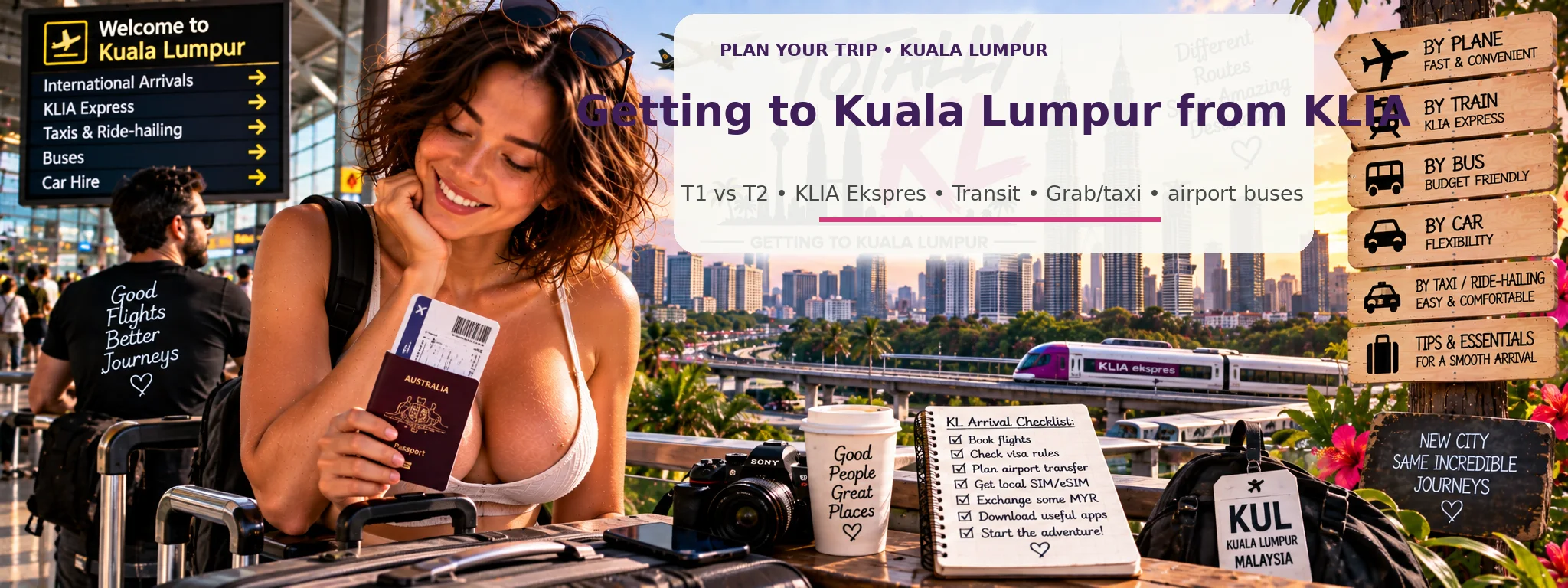

First: check whether your flight uses Terminal 1 or Terminal 2
Kuala Lumpur International Airport uses the airport code KUL, but it has two separate passenger terminals. Malaysia Airports now labels them KLIA Terminal 1 (T1) and KLIA Terminal 2 (T2). You will still see the older name “KLIA2” in old articles, bookings and conversation, but Terminal 2 is the current official airport wording.
Do not assume an airline always uses the same terminal forever. Check the terminal shown on your current airline booking or the official Malaysia Airports flight information before you travel. This matters most when you have separate tickets, a self-transfer, or a domestic connection after arriving internationally.
Terminal 1 and Terminal 2 are not one walkable building
T1 and T2 are part of the same airport system but are physically separate. If you arrive at one and depart from the other, allow time to collect baggage if required, clear immigration and customs where applicable, change terminals, then complete the next airline’s check-in and security process.
The airport rail link connects the terminals directly. Express Rail Link’s current timetable gives a journey time of about three minutes between KLIA T1 and T2. That train ride is short; the risky part of a self-transfer is everything around it. Separate-ticket travellers should build a generous buffer rather than treating “three minutes” as the total connection time.
KLIA Ekspres: the fastest predictable trip to the city
For most visitors staying near central Kuala Lumpur, KLIA Ekspres is the simplest option when speed and predictability matter. The current non-stop journey from KLIA T1 to KL Sentral takes 28 minutes; T2 is a few minutes farther. The operator currently runs the service every 20 minutes through the day, with late-night operating patterns that can differ from the normal non-stop service.
KL Sentral is not the tourist centre itself, but it is Kuala Lumpur’s main rail interchange. From there you can continue by urban rail or use a short Grab/taxi ride to your hotel. If you are staying in KLCC, Bukit Bintang, Chinatown or elsewhere away from KL Sentral, include that final leg when comparing the train with a direct car.
Choose KLIA Ekspres when road traffic is a concern, you are travelling light enough to handle one transfer at KL Sentral, or you simply want the most dependable airport-to-city journey time.
KLIA Transit: useful when your stop is not KL Sentral
KLIA Transit uses the same airport rail corridor but stops at Salak Tinggi, Putrajaya & Cyberjaya and Bandar Tasik Selatan before KL Sentral. The operator currently lists a total journey of about 39 minutes between T2 and KL Sentral.
Transit can be the smarter train if your actual destination is near Putrajaya or Bandar Tasik Selatan rather than central KL. Bandar Tasik Selatan also connects with the large TBS long-distance bus terminal, which is useful if Kuala Lumpur is only a transfer point in a wider Malaysia itinerary.
Grab or taxi: best for door-to-door convenience
A ride-hailing car is often the easiest choice for couples, families, groups with luggage, travellers arriving exhausted, or anyone staying far from KL Sentral. The trade-off is road traffic: unlike the airport train, the journey time can stretch substantially during peak periods, heavy rain or incidents on the expressway.
Use the current airport signage and app instructions for the designated e-hailing pickup area rather than standing at a random kerb. Malaysia Airports’ official Terminal 1 and Terminal 2 pages are the safest starting points for current terminal information.
Do not assume ride-hailing is always cheaper than rail for one person or always more expensive for a family. Compare the live car fare with the total train cost for your group and remember that the train may still require a second paid ride from KL Sentral.
Airport buses: slower, but useful on a tight budget
Airport coaches and buses are normally the lowest-cost way into the city. They are most attractive when you are not in a hurry, your accommodation is convenient to the bus arrival point, and you do not mind traffic variability. Exact operators, departure bays and timetables change more often than the core rail service, so confirm them at the terminal rather than relying on an old blog timetable.
A bus can be false economy if it leaves you at the wrong side of the city with heavy bags. Before buying a ticket, check the actual Kuala Lumpur stop and the final connection to your hotel.
Which airport transfer should you choose?
| Situation | Usually the best fit |
|---|---|
| Solo traveller, weekday traffic, hotel easy from KL Sentral | KLIA Ekspres |
| Family/group with several bags | Grab or taxi |
| Heading to Putrajaya or Bandar Tasik Selatan | KLIA Transit |
| Very tight budget and no time pressure | Airport bus |
| Late arrival near the end of rail service | Check the live train timetable first; keep a car option ready |
Late-night arrivals need a little more planning
Do not use a daytime frequency quoted in an old guide to plan a flight arriving around midnight. The current KLIA Ekspres page publishes first and last trains and notes a late-night operating pattern after 11:00pm. Check it on the day you travel, particularly if immigration, baggage delivery or a delayed flight could push you past the final useful service.
If you arrive after public transport has wound down, a booked or app-based car is the practical fallback. Save your hotel address offline before flying so you are not dependent on airport Wi-Fi at the exact moment you need to leave.
International-to-domestic and self-transfers
A single through-ticket with baggage checked to your final destination is very different from two independently booked flights. With separate tickets, you may need to enter Malaysia, collect bags, change terminal, re-check baggage and clear security again. Airline minimum connection times do not protect you in the same way when the bookings are unrelated.
If your next flight is from a different terminal, confirm it before leaving arrivals. For a high-stakes connection, build the itinerary around the possibility of queues at immigration, baggage delays and the terminal change — not around the best-case three-minute rail hop between T1 and T2.
From KL Sentral to KLCC, Bukit Bintang and other hotel areas
KL Sentral links into Kuala Lumpur’s wider urban rail network, but the best final route depends on your hotel. With luggage, a short ride-hailing trip can be easier than changing lines. If you are comfortable with local rail, our getting around Kuala Lumpur guide explains the MRT, LRT, Monorail and practical city transport choices.
First-time visitors should also check our best areas to stay before booking an airport transfer. “Kuala Lumpur city centre” can describe a broad area, and a hotel near KL Sentral is a very different transfer proposition from one in KLCC or Bukit Bintang.
Arriving in Kuala Lumpur by bus or train
Not everyone arrives by air. Long-distance buses commonly use Terminal Bersepadu Selatan (TBS) at Bandar Tasik Selatan, where local rail and KLIA Transit connections make onward travel relatively straightforward. Intercity rail arrivals may use KL Sentral or other stations depending on the service.
If you are travelling overland from Singapore, Penang or elsewhere in Peninsular Malaysia, focus less on the words “Kuala Lumpur” on the ticket and more on the exact arrival terminal. The final 20–40 minutes across the city can matter just as much as the long-distance leg.
Common airport-transfer mistakes
- Using the old “KLIA2” terminology as if it is a different airport code: both terminals use KUL; current official wording is T1 and T2.
- Going to the wrong terminal for departure: check your current booking, not the airline you remember using last time.
- Assuming the 28-minute train ends at your hotel: it ends at KL Sentral, so plan the final connection.
- Underestimating a self-transfer: terminal rail time is tiny compared with immigration, bags, check-in and security.
- Planning a midnight arrival from a daytime timetable: verify the current last train before you fly.
Official checks before you travel
For live airport and terminal information, use Malaysia Airports’ official KLIA T1 and KLIA T2 pages. For rail journey times, frequencies and first/last trains, use the official KLIA Ekspres and KLIA Transit pages. Check again close to travel whenever a missed connection would be expensive.