

The city in one paragraph
Kuala Lumpur is a modern Southeast Asian capital built from overlapping Malay, Chinese, Indian and international influences rather than one single city-centre personality. Glass towers and mega-malls sit near mosques, temples, markets and old shophouses; a polished KLCC afternoon can turn into a very different Chinatown dinner without leaving central Kuala Lumpur. The city is less naturally walkable than Singapore, but it is much easier to navigate than its traffic-heavy reputation suggests if you combine rail, covered walkways and e-hailing rather than relying on one mode for everything.
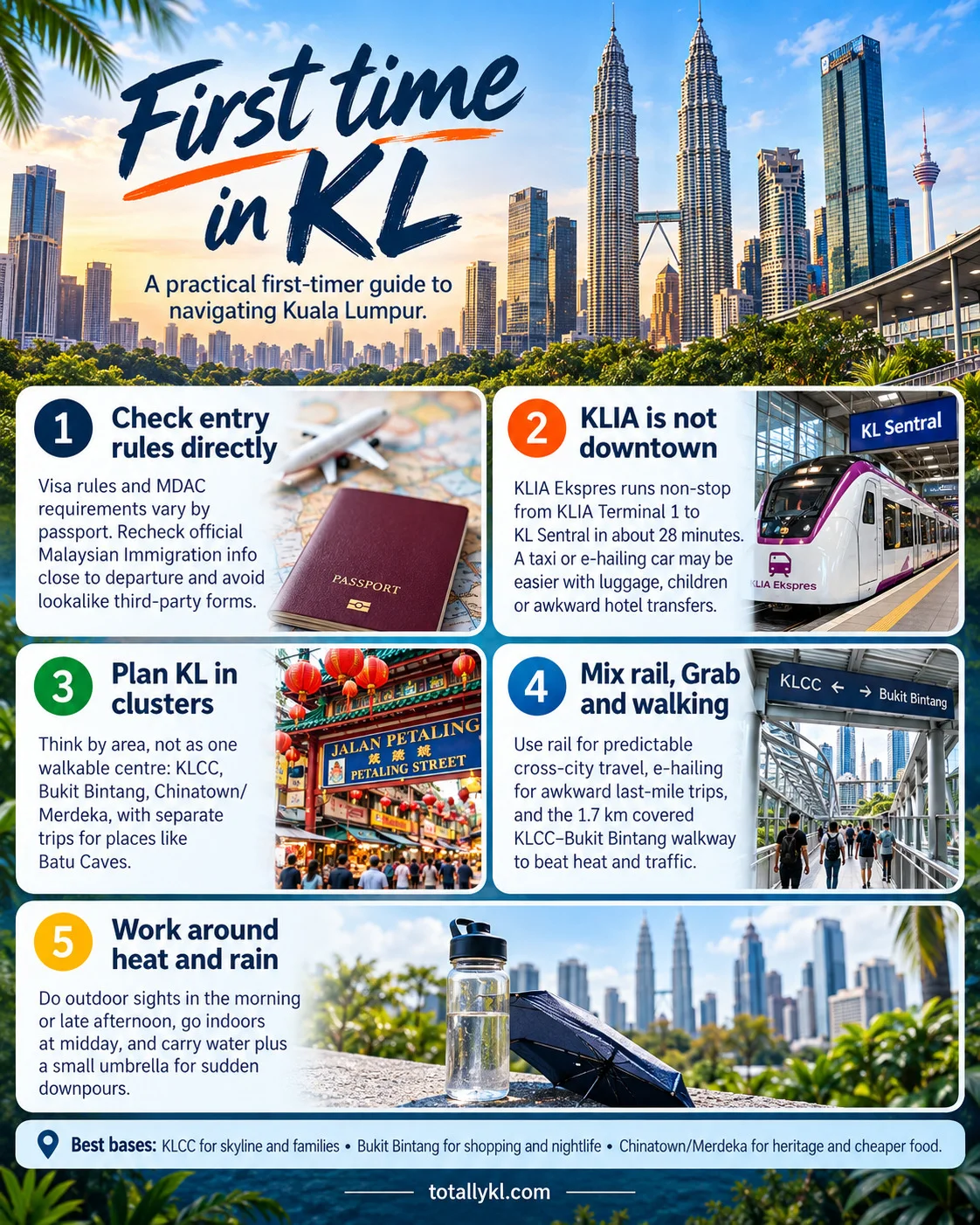
For a first visit, do not try to “understand Kuala Lumpur” as one neighbourhood. Think in clusters: KLCC for the skyline and park, Bukit Bintang for shopping and nightlife, Chinatown/Merdeka for heritage and food, and separate trips for places such as Batu Caves. Once you plan by area, the city becomes much more manageable.
Before you fly: check entry rules, not travel-blog summaries
Malaysia's entry requirements vary by passport and can change. The Malaysian Immigration Department's visa-requirement page is the right starting point for whether your nationality needs a visa or currently has an exemption. Do not assume a friend's recent entry conditions apply to you, and do not rely on an airline forum post for maximum stay or visa status.
Foreign visitors who are required to use the Malaysia Digital Arrival Card should complete it only through the official Immigration system. The official MDAC registration page states that the trip must be within three days, including the submission date, and asks for passport, travel and accommodation details. Check whether an exemption applies to your category rather than blindly completing third-party forms.
Search results can surface lookalike arrival-card services. Use the Malaysian Immigration domain for MDAC and current visa information, and recheck the rules close to departure.
KLIA is far from the city — choose your transfer deliberately
Kuala Lumpur International Airport is not downtown. The simplest rail option is KLIA Ekspres, which currently runs non-stop from KLIA Terminal 1 to KL Sentral in about 28 minutes, with Terminal 2 a few minutes farther. KLIA Transit uses the same airport corridor but stops at intermediate stations including Putrajaya & Cyberjaya and Bandar Tasik Selatan. The official airport-rail FAQ explains the current service pattern and onward rail connections.
The train is especially attractive when road traffic is heavy or you are staying near a useful rail connection from KL Sentral. A taxi or e-hailing car can be easier if you have several people, lots of luggage, children, or a hotel that would require an awkward interchange after the train. Price and travel time are not the only variables: count the door-to-door effort.
See the full getting to Kuala Lumpur guide before deciding, particularly if your flight arrives late at night when service frequency and onward transport options matter.
How to get around once you are in the city
Kuala Lumpur's rail network is useful but fragmented into multiple lines and station names that can look confusing on a first map. You do not need to memorise it. Use rail for predictable cross-city movement, especially when your origin and destination are close to stations, then use e-hailing for awkward last-mile trips, late returns or places poorly served by rail.
KLCC is served by the Kelana Jaya LRT and the newer Putrajaya MRT via Persiaran KLCC; Bukit Bintang is served by MRT and monorail; KL Sentral is the major interchange for airport rail and several urban services. MyRapid publishes current line and station information, so check live service information when disruptions or late-night timing matter.
Do not plan every transfer by road distance. A 3 km drive can take longer than expected in peak traffic, while a longer rail journey may be more predictable. Conversely, a short e-hailing ride can save a great deal of heat and walking if the rail interchange is indirect.
Walking: use shade, malls and covered links strategically
Central Kuala Lumpur can be walkable in pieces rather than continuously. KLCC itself is pleasant, and the Kuala Lumpur Convention Centre's covered 1.7 km KLCC–Bukit Bintang walkway makes those two major districts much easier to combine. Elsewhere, pavement quality, construction, major junctions and tropical weather can make a short map distance less pleasant than it appears.
Walk early or later in the day when possible, use malls as legitimate air-conditioned connectors, and keep a small umbrella because intense sun and sudden rain are both normal. A first-time itinerary that assumes European-style all-day walking usually becomes tiring long before the distances look impressive on paper.
Money: ringgit first, card plus some cash
The Malaysian Ringgit is written as MYR or RM. Tourism Malaysia notes that major hotels, shopping complexes, restaurants and shops widely accept international cards, while digital payments are common locally. That does not make Kuala Lumpur cashless: hawker stalls, market vendors and smaller businesses may be easier with cash, and a backup payment method is sensible if a terminal or foreign card fails.
Use bank or reputable ATM networks, decline poor dynamic-currency-conversion offers when your own bank gives a better rate, and understand your home bank's foreign transaction and withdrawal fees. You do not need to arrive with a holiday's worth of ringgit in your wallet. A mixed payment strategy is safer and more flexible.
Grab and e-hailing: useful, not your only transport plan
Grab is widely used for point-to-point trips and can make Kuala Lumpur feel very easy, particularly at night, with luggage or when rain makes walking miserable. But building an entire itinerary around cars can leave you sitting in traffic between neighbouring central districts. Use e-hailing where it solves a real problem rather than automatically replacing rail.
Download and set up the app before you need it, but do not assume a particular foreign card or wallet will always work. Keep another payment method and enough cash for a fallback. At large malls, convention centres and transport hubs, follow the designated e-hailing pickup point instead of dropping a pin on the wrong side of a multi-level complex.
Where to stay on a first trip
Your neighbourhood affects daily friction more than the star rating on the hotel. KLCC is easiest for skyline sights, families and a polished first visit. Bukit Bintang is stronger for shopping, nightlife and dense dining. Chinatown/Merdeka puts heritage, temples, markets and cheaper food closer. Other districts can be excellent for repeat visitors or longer stays, but a first trip benefits from being near the things you will actually do.
Read the best areas to stay guide and compare the actual walk to a useful station, not just the district label. A cheap room that requires two daily car rides can cost more time and money than a slightly dearer hotel in the right area.
Food is not a side attraction
Kuala Lumpur's food culture is one of the strongest reasons to visit. Malay, Chinese, Indian and Peranakan traditions overlap constantly, and your best meals may come from places that do not resemble formal restaurants. Do not spend every meal inside a hotel or international mall simply because those options are easy.
Start gently if you have just arrived: choose a busy, clean-looking stall or food court, drink enough water and build street-food exploration into areas you are already visiting. Chinatown, Jalan Alor, Kampung Baru, Brickfields and neighbourhood kopitiams all give different versions of the city rather than one definitive “KL food experience”.
Heat, humidity and rain change how much you can do
Kuala Lumpur is hot and humid throughout the year, with rainfall possible in any month. The mistake is not visiting in a particular season; it is scheduling outdoor sights back-to-back through the middle of the day with no indoor fallback. Tropical downpours can be intense and relatively short, but they can also disrupt road traffic and walking routes.
Build flexible pairs: park plus mall, heritage walk plus museum or café, outdoor viewpoint plus nearby indoor attraction. Carry water, use sun protection and take the midday slowdown seriously. Three well-spaced stops are often a better KL day than six geographically scattered pins.
Dress and etiquette: relaxed city, context still matters
Everyday Kuala Lumpur is generally relaxed, and visitor districts are used to international clothing. Religious sites are different. Mosques and temples may require more coverage, shoe removal or specific visitor routes, and active worship should take priority over photography. Carrying a light layer or scarf makes spontaneous visits easier.
Malaysia is multicultural and Muslim-majority, so public behaviour that seems unremarkable at home may read differently in a religious or family setting. You do not need to be anxious about etiquette; observe what people around you are doing, follow posted rules and ask before photographing individuals closely.
English and communication
Malay is the national language, while English is widely used across hotels, attractions, malls, transport and much of the service economy in Kuala Lumpur. You can travel independently without learning Malay, but a few basic words and a respectful tone are appreciated.
Keep your hotel name and address saved offline because similar hotel names and towers can confuse pickups. For markets or less tourist-focused places, showing a map pin is often more effective than trying to pronounce a long road name perfectly.
A realistic first afternoon
After arrival, resist the urge to cross the city chasing a checklist. Check in, eat, then choose one compact district. KLCC is an excellent first-afternoon option because the park, towers, Suria KLCC and Lake Symphony give you a recognisable introduction without complicated logistics. If you are staying around Bukit Bintang, walk the covered connection toward KLCC or keep the evening local and save the towers for the next day.
Jet lag plus humidity is a poor combination for an ambitious first day. The goal is to understand your neighbourhood, get cash or a working payment method, test one rail or e-hailing journey and eat well — not “complete” Kuala Lumpur before bedtime.
A sensible first full day
- Morning: choose one outdoor or heritage cluster while temperatures are lower — for example Merdeka Square/Chinatown or KLCC Park and the towers.
- Midday: move indoors for lunch, a museum, Petrosains, Aquaria or a major mall rather than fighting the hottest part of the day.
- Late afternoon: return outdoors in the same part of town or use rail to one second district.
- Evening: make food the destination — a hawker area, neighbourhood restaurant or night market rather than another major attraction.
This structure teaches you how KL works while leaving room for weather and traffic. On day two, you can confidently add a farther outing such as Batu Caves or a more specialised neighbourhood.
Common first-timer mistakes
- Treating “Kuala Lumpur” as one walkable centre. Plan by neighbourhood clusters.
- Using only Grab. Cars are convenient, but rail and covered walkways often beat traffic in the core.
- Using only rail. Some last-mile trips are genuinely easier by e-hailing.
- Ignoring the airport distance. Your KLIA transfer is a real journey, not a downtown airport hop.
- Overpacking the midday hours. Heat and storms change your usable pace.
- Assuming entry rules from someone else's passport. Check Immigration directly.
- Staying “near” a landmark without checking the walking route. Central roads and multi-level developments can be deceptive.
What to organise before leaving the airport
Have four things clear: how you are reaching the hotel, the hotel's exact address, a working payment method, and enough mobile connectivity to use maps and contact the property. You can solve everything else later. Kuala Lumpur has abundant ATMs, malls, convenience stores, food and transport; it is not a destination where a minor forgotten item needs to become a crisis.
If you arrive very late, prioritise a simple safe transfer and sleep. Do not force a complicated rail interchange merely because it is theoretically cheaper, and do not assume every station, counter or hotel service runs at daytime frequency.
Bottom line for a first visit
Kuala Lumpur rewards travellers who leave space between the landmarks. The city is not difficult; it is simply spread across different districts and shaped by tropical weather. Use rail where it is direct, e-hailing where it saves friction, walk the good pedestrian links, and let food and neighbourhoods carry as much weight as the famous sights.
Before departure, verify your own entry requirements and MDAC situation, decide how you will get from KLIA to the city, and choose a base that matches your first two days. Once those three decisions are made, the rest of Kuala Lumpur becomes remarkably forgiving.