

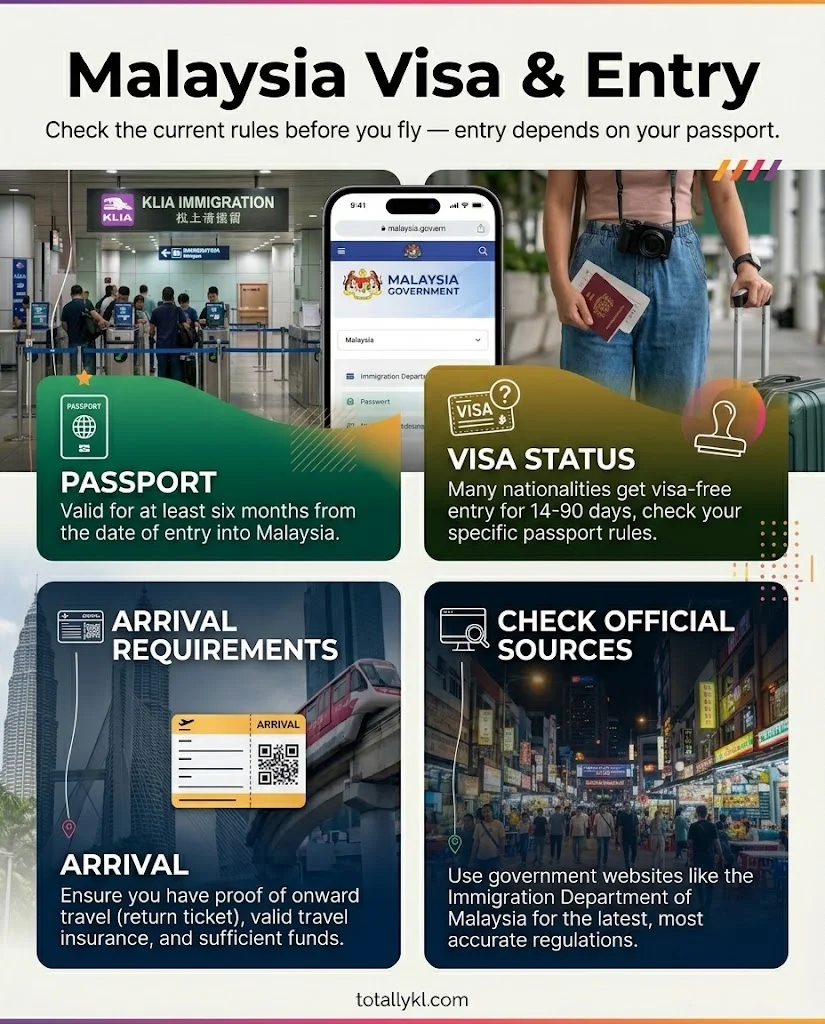
Start with your passport, not a generic “visa-free” claim
Malaysia does not have one tourist-entry rule that can be safely summarised for every visitor. Visa requirements depend on nationality, and exemptions can be introduced, extended or withdrawn. The Malaysian Immigration Department's visa-requirement-by-country page is the right first check before you book around a particular stay length or visa status.
That official page is also why this guide does not reproduce a giant country list. In 2026, for example, Immigration notes specific temporary treatment for some nationalities and separate rules for ASEAN nationals. A static copy would age badly. Check your own passport directly, then read the conditions attached to the route that applies to you.
Visa and permission to stay are related but not identical
A visa is permission to travel to Malaysia under the relevant category; your actual entry and permitted stay are determined by Malaysian Immigration when you arrive. Tourist and ordinary social visits commonly fall under the Short Term Social Visit framework, but the exact permission and duration attached to your nationality should be checked against current official guidance.
Do not treat “I can board without applying for a visa” as permission to work, study or remain indefinitely. The Immigration Department lists tourism and ordinary social visits among Short Term Social Visit purposes; work, study and other long-term purposes use different immigration routes.
The Malaysia Digital Arrival Card (MDAC)
Foreign visitors who are required to submit a Malaysia Digital Arrival Card should use the official Immigration MDAC registration portal. The current form states that your trip must be within three days, including the date of submission, and asks for passport details, arrival and departure dates, transport information and your address in Malaysia.
MDAC is an arrival-card process, not a substitute for a visa when your nationality requires one. Conversely, holding a visa does not mean you should ignore MDAC if the arrival-card rule applies to you. Immigration publishes separate MDAC information and eligibility material, so check both pieces rather than assuming one replaces the other.
Search results can contain third-party arrival-card services. Submit MDAC through the Malaysian Immigration domain and check the official page for exemptions or changed procedures before travel.
Who can use Malaysia's eVISA system?
Malaysia's official electronic visa platform is MYVISA, operated by the Immigration Department. It is not something every traveller needs. The current official FAQ explains that eVISA applies to specified nationalities and social-visit purposes, while other nationalities may be visa-exempt or use different routes.
If your passport requires an eVISA, follow MYVISA's eligibility and document instructions rather than an agent's generic checklist. The official FAQ currently advises applicants to apply ahead of travel and lists supporting documents such as a passport biodata page, travel evidence and accommodation evidence for relevant applications.
Single-entry, multiple-entry and transit visas
Malaysia Immigration describes three broad visa types: Single Entry Visa, Multiple Entry Visa and Transit Visa. The conditions are not interchangeable. A multiple-entry visa can carry nationality-specific and purpose-specific conditions, while a transit visa concerns travellers who require permission to enter Malaysia while transiting rather than simply remaining airside on the same onward journey.
If your itinerary involves leaving Malaysia and returning — for example Kuala Lumpur, Singapore, then Kuala Lumpur again — check whether your immigration route permits the number of entries you plan. Do not assume a visa that allowed the first arrival automatically covers the second.
Tourism and the Short Term Social Visit Pass
The Immigration Department's Short Term Social Visit Pass guidance explicitly includes tourism, visiting relatives, meetings, conferences and several other short-visit purposes. That page is useful because it explains the framework behind an ordinary visitor stay rather than only whether a pre-travel visa is required.
If your purpose changes — employment, formal study, long-term residence or another regulated activity — do not try to stretch a tourist/social-visit permission to fit it. Use the immigration category designed for the actual activity.
Extensions are not a normal holiday-planning strategy
Malaysia Immigration says an extension of a Short Term Social Visit Pass may be considered in special circumstances such as illness, accident or war in the visitor's home country, with supporting evidence and onward/return travel evidence. That is very different from assuming you can routinely extend a holiday because you want more time.
If you already know you need a longer stay than your normal tourist permission allows, solve that before travel by checking the correct visa/pass route. Do not build a long trip around an extension you have not been granted.
Passport validity: check the rule attached to your route
“Six months' passport validity” is common travel advice, but it should not be quoted as a universal Malaysian rule without context. MYVISA's current eVISA FAQ requires the passport biodata page used for an eVISA application to have more than six months' validity from the travel date. Airlines and other immigration routes may also apply document-validity requirements.
Practically, if your passport is close to expiry, resolve that well before the trip. A technically nuanced validity rule is not worth testing at an airline check-in desk. Verify the current Immigration requirement for your visa/entry category and your carrier's document rules.
Onward tickets, accommodation and funds
Visitors should be ready to show that their trip makes sense. MYVISA documentation for relevant visa applications includes travel and accommodation evidence, and Malaysia's immigration framework allows officials to consider whether a visitor has the means to support themselves. The Short Term Social Visit extension process also specifically refers to confirmed onward or return travel.
That does not mean every tourist will be asked for a bank statement and hotel printout at the counter. It means you should be able to produce your onward itinerary, first accommodation address and supporting booking information if requested. Keep them accessible offline in case airport Wi-Fi or roaming is unreliable.
Arrival at KLIA: what to keep handy
- Your passport and any required visa/eVISA approval.
- Your MDAC confirmation/details if MDAC applies to you.
- Your first Malaysian accommodation address.
- Your onward or return itinerary.
- Evidence supporting the purpose of your trip if it is more than ordinary tourism.
Do not bury all of this in an email account that requires a one-time code sent to a SIM you cannot access. Save key confirmations to your phone before take-off.
eGates and MDAC are not the same thing
Malaysia Immigration also publishes eGate eligibility for certain foreign travellers. Current official guidance ties foreign-traveller eGate eligibility to factors including nationality/category, an e-passport and MDAC submission, with exceptions for some long-term or permanent residents. Eligibility to use an automated gate is a processing convenience; it does not change the underlying visa or stay conditions.
If the eGate does not accept you, follow airport staff directions to a staffed immigration counter. Do not treat an eGate problem as proof that your visa or MDAC is invalid.
Children and family travel
Each traveller's passport and immigration status matters individually. MYVISA's current eVISA guidance includes extra documentation for minors in relevant applications. Families should therefore check each passport rather than assuming a parent's visa-free or eVISA status automatically covers every child.
Keep birth or guardianship documents available when your situation could reasonably require them, particularly if a child travels with one parent, another relative or a guardian. Requirements can depend on nationality and circumstances, so verify with the relevant authority rather than relying on a generic family-travel checklist.
Working remotely is an immigration question, not a Wi-Fi question
Kuala Lumpur is easy to work from technically, but immigration permission and internet access are separate issues. A tourist/social visit does not become employment permission simply because the work is done on a laptop. If you plan to work, take paid assignments, study formally or remain long term, check the correct Malaysian pass or visa category before travel.
This site deliberately does not turn a visitor guide into legal advice on employment status. Use Malaysia Immigration and, where necessary, a qualified immigration professional for your exact circumstances.
Do not overstay
Your permitted stay is a legal limit, not a planning suggestion. Check the period granted to you and leave or regularise your status before it expires. Do not infer your allowed stay from another traveller's passport stamp, nationality or visa type.
If you think there is an error in your admitted period, or an emergency prevents departure, contact Malaysian Immigration promptly rather than waiting until the final day.
Common entry mistakes
- Copying a visa-free list from an old article. Use the current Immigration country page.
- Submitting MDAC too early. The current official form uses a three-day trip window including submission day.
- Paying a lookalike website for MDAC. Use the government portal.
- Assuming eVISA is mandatory for everyone. It only applies where your nationality/purpose requires it.
- Confusing visa validity with permitted stay. They are not the same concept.
- Planning to extend a normal holiday casually. Immigration describes social-visit extensions as special-consideration cases.
- Ignoring multiple entries. A side trip can matter if your visa is single-entry.
A safe pre-flight checklist
- Open the current Malaysia Immigration visa-requirement page and find the rule for your passport.
- If a visa is required, use the official MYVISA route or other official process that applies to your category.
- Within the official MDAC timing window, submit MDAC if your traveller category requires it.
- Save your hotel address, onward itinerary and relevant confirmations offline.
- Recheck your passport validity and airline document requirements.
- If your purpose is work, study or long stay, stop using tourist guidance and check the correct pass.
What to recheck close to departure
Immigration rules are volatile enough that a page reviewed today can still become stale. Before you fly, recheck the official Malaysia Immigration Department, your country's visa requirement, the MDAC portal and MYVISA if relevant. Also check your airline's travel-document guidance because the carrier must decide whether it can board you.
Then move on to the easier parts of the trip: getting from KLIA into Kuala Lumpur, choosing where to stay, and planning your first day in the city.
Bottom line
Malaysia's visitor-entry system is not difficult when you use the right source. Check the rule for your own passport, complete MDAC in the official timing window if required, apply through MYVISA only if your route needs a visa, and keep straightforward evidence of your trip available.
The risky approach is not “forgetting a secret Kuala Lumpur rule”; it is relying on a static country list, a third-party arrival-card site or someone else's entry experience. Malaysian Immigration is the authoritative source, and it should be the final check before every trip.