
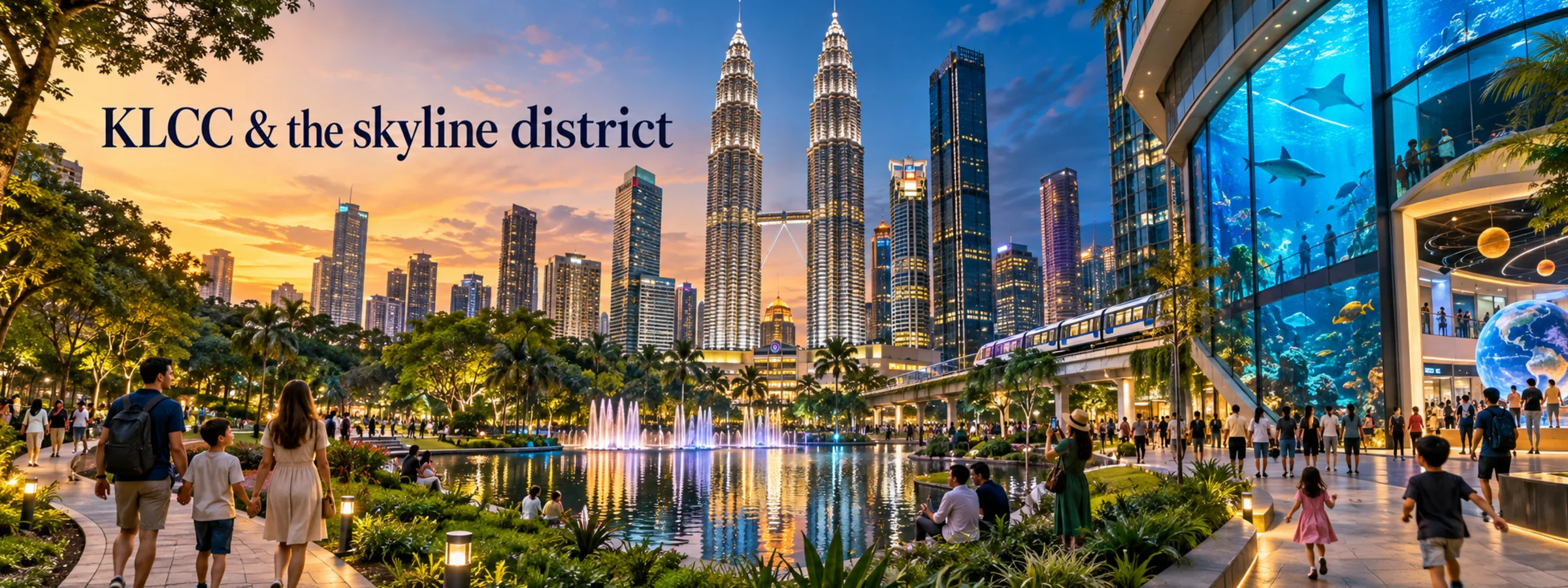
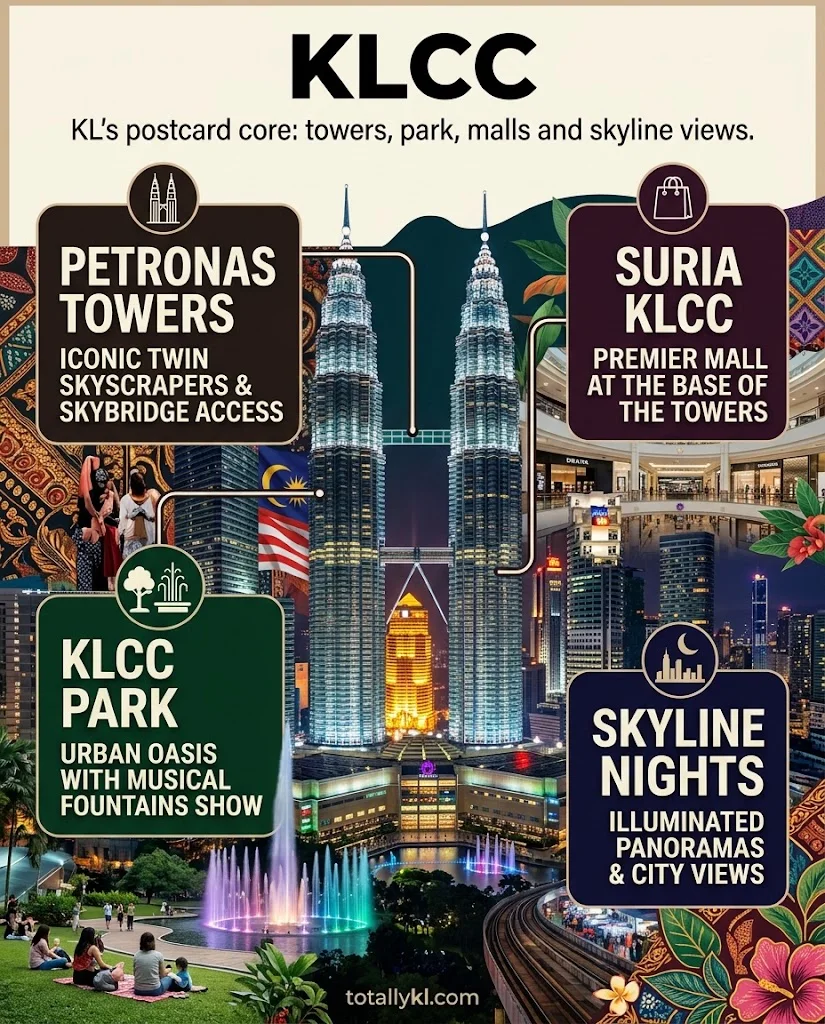
KLCC is Kuala Lumpur in its most polished, high-rise form: the PETRONAS Twin Towers, a major shopping centre, a landscaped city park, convention facilities, luxury hotels and family attractions clustered into one highly walkable precinct. It is not the neighbourhood to choose if your priority is cheap street food or old shophouse atmosphere, but it is one of the easiest parts of Kuala Lumpur for a first-time visitor to understand.
The big advantage is convenience. You can arrive by rail, spend several hours without needing a car, move between indoor and outdoor attractions, eat at almost any budget, and finish with the towers lit above the park. KLCC also works unusually well in wet or very hot weather because Suria KLCC, Petrosains, the Convention Centre link and Aquaria give you substantial indoor options.
What KLCC actually means
KLCC stands for Kuala Lumpur City Centre, but visitors often use the name more loosely for the skyline district around the PETRONAS Twin Towers. The core is the integrated complex of the towers, Suria KLCC, KLCC Park and the Kuala Lumpur Convention Centre, with offices, hotels and residential towers spreading outward toward Jalan Ampang, Jalan P. Ramlee and Persiaran KLCC.
That matters when booking accommodation. A hotel marketed as “KLCC” may be directly beside the park, or it may be a longer walk across busy roads on the edge of the district. Check the actual map pin and the nearest rail station rather than trusting the neighbourhood label alone.
The PETRONAS Twin Towers are the anchor
The towers define the district visually and are the obvious first stop for many visitors. If you want to go up, treat it as a timed attraction rather than something to improvise at the last minute. The official PETRONAS Twin Towers visitor site publishes current opening days, timed-entry rules and ticket availability, and recommends arriving before your booked slot.
If you only want the classic view, you do not need a tower ticket. The park and surrounding plazas give excellent free angles, especially around late afternoon and after dark. Our PETRONAS Twin Towers guide goes deeper on the Skybridge, observation levels, booking strategy and photo locations.
KLCC Park is more than a photo foreground
The park is one of the reasons KLCC works as a real district rather than just a mall-and-office complex. KLCC's own published material describes a large urban park designed by Brazilian landscape architect Roberto Burle Marx, with a 1.3-kilometre jogging track, children's playground and pool, water features, shaded areas and the Lake Symphony fountains.
Use the park as a reset between indoor attractions. Early morning is best for walking or running before the heat builds. Late afternoon is better for skyline photos and people-watching. Around sunset, the open lawns and lake edge become the natural place to wait for the towers to light up.
Do not build an evening around an unofficial fountain-show timetable copied from an old blog. Programmes can change. Treat Lake Symphony as a bonus while you are already at the park, and check current KLCC or Suria KLCC information if the show is essential to your plans.
Suria KLCC: useful even if you hate malls
Suria KLCC sits directly beneath the towers and is the practical indoor hub of the district. It has restaurants, cafés, supermarkets and services as well as luxury retail, so it is genuinely useful even for travellers who have no interest in shopping. The mall's official information lists daily opening from 10am to 10pm at the time of writing, including public holidays; check again if your visit depends on a particular store or service.
More importantly, the mall connects directly to KLCC LRT station and acts as a weatherproof transition point between the towers, park and surrounding offices. In a tropical downpour, that connectivity can save a day that would otherwise dissolve into waiting under awnings.
Petrosains is the strongest family option in the core
Petrosains, The Discovery Centre is on Level 4 of Suria KLCC. It is a hands-on science centre rather than a passive museum, and the official visitor guidance recommends allowing roughly 2.5 hours for a fuller visit. That makes it substantial enough to be a main activity, particularly with school-age children.
Tickets are time-slotted and availability can tighten on weekends, public holidays and school holidays. If Petrosains is important to your family, book before arriving instead of assuming you can fill a random rainy afternoon. The science-centre visit pairs naturally with lunch in Suria KLCC and late-afternoon time in the park.
Aquaria KLCC is not inside the mall
This is a common navigation mistake. Aquaria KLCC is beneath the Kuala Lumpur Convention Centre, not inside Suria KLCC. It is still easy to combine with the towers because the Convention Centre precinct is linked into the same broader pedestrian network.
Aquaria's official site describes a 60,000-square-foot aquarium with thousands of aquatic and land-animal exhibits and a long underwater tunnel. Current published opening information should be checked before visiting; at the time of review, the official site listed daily hours with last entry before closing. Families who want both Aquaria and Petrosains should avoid cramming them around a tower time slot unless the children have unusually high stamina.
Getting to KLCC by train
The simplest arrival for most visitors is the Kelana Jaya LRT line to KLCC station, which has signed access to Suria KLCC. Suria's official getting-here page confirms the direct LRT connection. The MRT Putrajaya Line also serves Persiaran KLCC, useful for travellers approaching from stations on that corridor.
These stations are close but not identical. If you are meeting someone or heading to a specific hotel, check which exit is nearest rather than simply following “KLCC” signs and assuming every tower entrance is the same. For a broader network overview, see our getting around Kuala Lumpur guide.
Walking from Bukit Bintang
KLCC and Bukit Bintang are close enough to combine in one day, but “walkable” in Kuala Lumpur does not always mean pleasant at street level. The practical route uses the covered pedestrian connection between the Pavilion/Bukit Bintang area and the Convention Centre side of KLCC. It is especially useful in midday heat or rain.
A good first-time itinerary is to explore Bukit Bintang earlier, move toward KLCC in the late afternoon, spend time in the park and finish with the skyline after dark. That gives you two very different versions of central Kuala Lumpur without wasting time in traffic.
Grab, taxis and driving
Grab is useful if you are carrying luggage, travelling with small children or coming from a district without a convenient rail connection. Suria KLCC's official access guidance identifies a taxi and Grab drop-off near its Jalan P. Ramlee entrance. At peak periods, however, road congestion around the towers can make rail faster and more predictable.
If you drive, use official parking and check current rates rather than relying on old travel-blog figures. KLCC Parking Management publishes current operating and payment information for its facilities. For a short sightseeing visit, driving is rarely necessary unless KLCC is one stop in a wider car-based day.
Where to eat
KLCC is easy for food but not always the best place to seek Kuala Lumpur's most distinctive eating experience. Suria KLCC gives you everything from quick food-court meals to destination restaurants, which is convenient for families and mixed groups. Hotels around the park add bars, buffets and higher-end dining.
For more character, use KLCC for an attraction block and eat elsewhere. Jalan Alor, mamak restaurants and neighbourhood dining in Chinatown or Brickfields show a different side of the city. The right answer is not “avoid mall food”; it is to know when convenience matters and when it is worth travelling for atmosphere.
Is KLCC a good place to stay?
Yes, if your priorities are convenience, skyline views, modern hotels and easy first-day logistics. It is particularly good for short stays, business trips, families who value indoor backup options, and travellers who want a polished base with straightforward transport.
Less so, if your priorities are nightlife at your doorstep, budget accommodation, heritage streets or street-food density. Bukit Bintang usually wins for nightlife and central energy; Chinatown for heritage atmosphere and lower-cost options; Bangsar or TTDI for a more residential food-and-café feel. Compare the trade-offs in our best areas to stay in Kuala Lumpur guide.
KLCC with children
KLCC is one of the easiest central districts with children because you can alternate between outdoor space and air-conditioned attractions. A realistic family sequence is Petrosains or Aquaria in the morning, lunch indoors, downtime, then the park when the sun is lower. Trying to add both major family attractions, a tower visit, shopping and an evening show in one day is possible on paper but rarely enjoyable.
The park's playground and children's pool are valuable decompression stops, but bring sun protection, water and a change of clothes if the pool is part of the plan. Always follow posted local operating and safety information on the day.
KLCC after dark
The district is at its most visually dramatic after sunset. The towers become the focal point, the park cools slightly, restaurants fill and the skyline feels more coherent than it does under flat midday light. For photographers, the useful strategy is to arrive before dusk so you can capture daylight, blue hour and fully illuminated night views without changing location.
KLCC is lively at night but it is not Kuala Lumpur's strongest nightlife district. If you want bars and late-night energy, continue toward Bukit Bintang or other dedicated nightlife areas after the skyline stop.
How long do you need?
| Time available | Best use of KLCC |
|---|---|
| 1–2 hours | Park, tower exterior, Suria KLCC and skyline photos |
| Half day | Add one major attraction: Twin Towers, Petrosains or Aquaria |
| Full day | Two attractions, relaxed meals, park time and an evening skyline finish |
For most adult visitors who are not shopping, a half day is enough. A full day makes more sense for families, poor-weather days or travellers combining a timed tower visit with another paid attraction.
Common KLCC mistakes
- Assuming everything labelled KLCC is beside the towers. Check the actual hotel or restaurant location.
- Booking back-to-back timed attractions. Security queues, meals, children and walking time make the district bigger than it appears.
- Driving at peak time when rail would be simpler. Central traffic can erase any apparent door-to-door advantage.
- Spending the whole visit indoors. The park is a major part of the experience and gives the best sense of the towers' scale.
- Eating every meal here by default. KLCC is convenient, but Kuala Lumpur's food culture is much broader than this district.
- Trusting old opening-hour or fountain-show posts. Check official sources for anything time-sensitive.
A strong first-time KLCC plan
Arrive by LRT or MRT in mid-to-late afternoon. If you have a booked tower slot, build around it; otherwise start with Suria KLCC or one indoor attraction. Move into KLCC Park as the heat eases, walk the lake and garden paths, then choose a tower-photo position before sunset. Stay through blue hour and the first part of the illuminated evening, then eat locally for convenience or continue to Bukit Bintang for a more energetic night.
That sequence captures what KLCC does best: easy transport, air-conditioned comfort when you need it, one of Kuala Lumpur's defining landmarks, a genuinely useful city park and a skyline that becomes far more impressive after dark.