
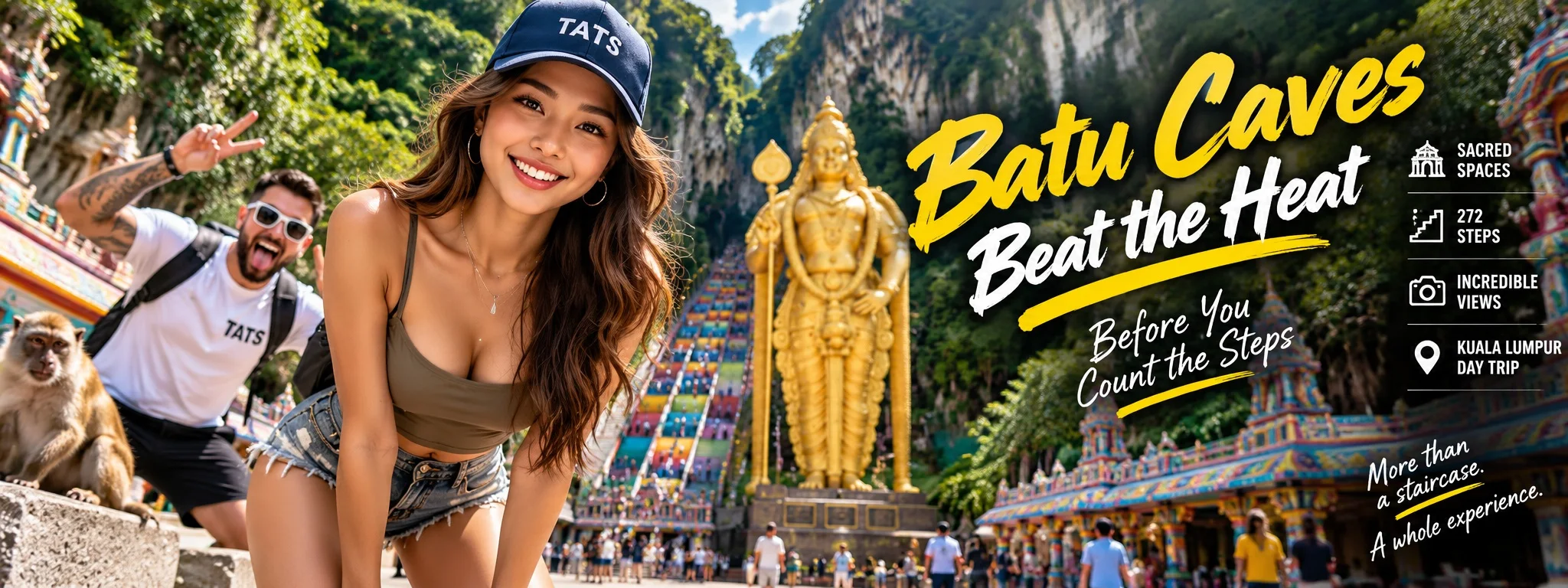

Batu Caves is not simply a colourful staircase outside Kuala Lumpur. It is an active Hindu pilgrimage site built into a vast limestone outcrop in Gombak, Selangor, with the Temple Cave as its spiritual centre. The 272 steps, huge golden statue of Lord Murugan and cathedral-like cave interior make the first visual impression, but the visit is more rewarding if you understand that worship continues around you throughout the day.
For most travellers, Batu Caves is a half-day outing, not a full-day expedition. The KTM Komuter makes it possible to reach the complex directly from central Kuala Lumpur without a tour, and the main Temple Cave remains free to enter. The biggest planning variables are heat, train timing, crowds and the physical climb.
What Batu Caves actually is
The site combines natural limestone caves with Hindu temples and shrines. Tourism Malaysia describes the hill as roughly 400 million years old and records Batu Caves becoming a Hindu religious site in the late nineteenth century. Today it is closely associated with the worship of Lord Murugan and with Thaipusam, when the atmosphere changes from normal visitor day to major pilgrimage.
The main visitor route begins in the broad forecourt beneath the golden Murugan statue, climbs the brightly painted staircase and enters the enormous Temple — or Cathedral — Cave. Natural openings in the rock let light into the chamber above the shrines, so the cave feels less like a conventional enclosed building and more like a sacred space carved into the hill itself.
The 272 steps: what the climb is really like
There are 272 steps from the base to the main cave. The climb is straightforward for a reasonably mobile traveller, but Kuala Lumpur's heat and humidity make it more tiring than the number suggests. The steps are steep enough that you should pace yourself, use the landings and avoid treating it as a race.
Go early if possible. The first part of the morning is cooler, the staircase is easier to photograph without dense crowds, and you have more energy to focus on the temple once you reach the top. Midday is usually the least comfortable time to climb because the exposed stairway can feel punishing in direct sun.
If 272 steep steps would be unsafe or unrealistic for you, Batu Caves can still be culturally interesting from the ground-level temple area, but the famous main cave does not have a simple lift alternative. Plan around your actual mobility rather than feeling pressured to complete the climb.
What to see at the top
The reward is not a conventional viewpoint but the scale of the cave itself. Temple Cave has a huge ceiling, natural openings and working shrines. People may be praying, making offerings or taking part in ceremonies while visitors move through the same space. Keep your voice down, give worshippers room and avoid blocking shrine entrances for photographs.
Allow time to look upward and back toward the staircase. The experience is more memorable when you stop thinking only about the photo at the bottom and notice how the religious structures sit inside the geology.
How much does Batu Caves cost?
The headline attraction — the Temple Cave / Cathedral Cave — is free. Tourism Malaysia's May 2026 visitor information lists paid admission only for some optional side attractions, with separate charges for places such as Cave Villa and Ramayana Cave. Those prices can change, so use the current Tourism Malaysia Batu Caves information rather than treating an old blog price as permanent.
You do not need to buy a city tour simply to gain access to the main cave. A tour may still be worthwhile for commentary, transport convenience or combining several sites, but it is buying a service, not a special entrance entitlement to Temple Cave.
Current opening hours
Tourism Malaysia currently lists Batu Caves operating from 6:00am to 9:00pm daily for the main visitor complex. Side attractions can keep different hours, and religious observances can affect how parts of the site feel or function. If a specific paid cave is important to you, check its current operation separately rather than assuming the entire complex shares one timetable.
Early morning is the strongest general recommendation. Late afternoon can also work when the heat starts easing, but you have less buffer if transport is delayed or a side attraction closes earlier than the main temple area.
Getting there by KTM Komuter
The easiest independent route is the KTM Komuter Batu Caves–Pulau Sebang line. Batu Caves is the terminal station, and the temple complex is close enough that the arrival is simple even for a first-time visitor. This is one of the rare major Kuala Lumpur sights where the train can be easier than fighting road traffic.
Do not copy an old train frequency into your plans. KTMB currently publishes separate weekday and weekend/public-holiday timetables for the Batu Caves line, with 2026 schedules taking effect on different dates. Check the official KTMB timetable page before leaving, especially if you are trying to connect with another timed activity later in the day.
KL Sentral, Kuala Lumpur station or another stop?
KL Sentral is the obvious boarding point for many visitors because it is the city's main transport hub, but it is not the only one. Depending on where you stay, the Komuter line also serves stations such as Kuala Lumpur and Bank Negara. Use your map to choose the station that genuinely reduces transfers rather than automatically crossing the city to KL Sentral first.
Allow buffer time. Komuter services are useful but not metro-frequency in every period, so missing one train can cost more time than missing an LRT service in central KL.
Grab or taxi: when it makes more sense
A Grab can be the better option for a family, a small group or anyone leaving from a hotel far from the Komuter line. It also gives you flexibility to arrive very early before you want to navigate a station. The trade-off is road traffic, which can become unpredictable later in the morning.
For the return journey, compare the live road situation with the next train rather than committing to one method in advance. Independent travel works well because you can choose train in one direction and a car in the other if that suits the day.
Dress code and temple etiquette
Batu Caves is a place of worship. Wear clothing that is respectful of a Hindu temple environment: shoulders and knees should be reasonably covered, and avoid treating the site like a beach or gym stop. Requirements and enforcement can vary by area and occasion, so modest clothing is the easiest way to avoid a problem.
Inside worship spaces, move around ceremonies rather than through them. Do not photograph someone at close range while they are praying without permission. Keep shoes, food and personal belongings where signs or temple staff direct you. Our broader KL etiquette guide is useful context if Batu Caves is your first religious site in Malaysia.
The monkeys: watch your food, not your camera
Long-tailed macaques are common around the staircase and cave complex. They are wild animals that have become accustomed to people and food. Keep snacks, plastic bags and loose items secured, and do not feed or tease them. A monkey approaching closely is not an invitation for a selfie.
Food-conditioned animals can become bold. The simplest prevention is to keep your hands empty while climbing and leave food packed away until you are back in an appropriate eating area.
Murugan statue and photography
The golden Lord Murugan statue at the foot of the stairs is one of Malaysia's most recognisable religious landmarks. Tourism Malaysia lists it at roughly 43 metres high. The classic wide photograph combines the statue, limestone cliff and rainbow staircase, but the forecourt is also an active arrival space, so do not stand in vehicle or pedestrian flows just to centre a shot.
Photography is easiest early because the light is softer and the forecourt is less congested. At the top, be more conservative with the camera around worship and ceremonies than you would be on the open staircase.
Ramayana Cave, Cave Villa and other side attractions
Not every visitor needs to add every paid cave. Ramayana Cave uses colourful scenes to depict the Hindu epic; Cave Villa is a separate attraction near the base. If you have limited time, the free Temple Cave is the clear priority and already delivers the experience most travellers associate with Batu Caves.
Some older guides still describe the Dark Cave as a normal bookable attraction. Do not assume that historic description is current. Availability has changed over the years, so verify any specialist cave tour independently before travelling for it.
Thaipusam: a completely different visit
During Thaipusam, Batu Caves becomes the focus of a major Hindu pilgrimage. Tourism Malaysia describes devotees travelling from the Sri Maha Mariamman Temple area in central Kuala Lumpur toward Batu Caves, with religious acts including carrying kavadi and pots of milk. This is not simply a larger version of a normal sightseeing day: transport, crowd density, walking routes and the spiritual atmosphere are all different.
If you intentionally visit for Thaipusam, approach it as a religious festival rather than entertainment. Expect very large crowds and follow local instructions. KTMB has operated special extended services for Thaipusam, but those arrangements are event-specific; check the current year's official transport notice rather than assuming the previous schedule repeats.
How long should you allow?
If you travel independently by train, allow roughly three to four hours door to door from central Kuala Lumpur for a comfortable visit: transport both ways, the climb, time inside the cave and some flexibility for waiting. The actual temple portion can be much shorter, but the outing becomes rushed if you schedule another fixed booking immediately after it.
Travellers who add side caves, a meal or extended photography can easily spend half a day. There is little reason to turn Batu Caves into a full day unless you are combining it with another Gombak/Selangor attraction.
Families, heat and accessibility
Children who are comfortable with stairs often enjoy the visual drama of Batu Caves, but the combination of heat, monkeys and steep steps requires supervision. Carry water, take breaks and avoid the middle of the day where possible. A child who can climb 272 steps at home may find the tropical heat changes the equation.
For visitors with limited mobility, the staircase is the central barrier. The ground-level forecourt, statue and temple activity can still make the trip worthwhile, but the main cave experience is inherently stair-dependent. If the climb is not safe for you, do not let online "must-do" language push you into it.
What to wear and bring
- Comfortable shoes with decent grip for the staircase.
- Light, modest clothing suitable for heat and a working temple.
- Water, especially if you are arriving after the early morning.
- A small secure bag rather than loose food or plastic bags that attract macaques.
- Sun protection for the exposed base and staircase.
Common mistakes
- Going at midday because the map says it is close: the heat makes the climb much harder.
- Treating it as a photo set: worshippers are using the same space for religious purposes.
- Feeding monkeys: it encourages exactly the aggressive behaviour visitors complain about.
- Assuming the train runs every few minutes: check the current KTMB timetable.
- Buying a tour because you think the main cave requires a ticket: Temple Cave is free.
- Trying to add too many side attractions: the staircase and main cave are the essential experience.
Is Batu Caves worth it?
Yes, for most first-time Kuala Lumpur visitors. It offers something the city-centre towers and malls cannot: a major living religious site, dramatic geology and a strong sense of Malaysia's Hindu heritage, all within an easy half-day radius of the centre. The trip is particularly good value because the main cave is free and public transport can take you almost to the entrance.
The right way to visit is not to maximise the number of photos or caves. Arrive early, climb slowly, behave like a guest at a temple, spend time inside the main cavern and leave enough transport buffer that you are not checking your watch on every step.
Official sources and final check
For current planning, use Tourism Malaysia's Batu Caves visitor information for the main site, hours and admission context; the official KTMB timetable page for current weekday/weekend Batu Caves services; and Tourism Malaysia's Thaipusam information if you are travelling around the festival. Train schedules, side-attraction prices and festival arrangements are the details most likely to change.