

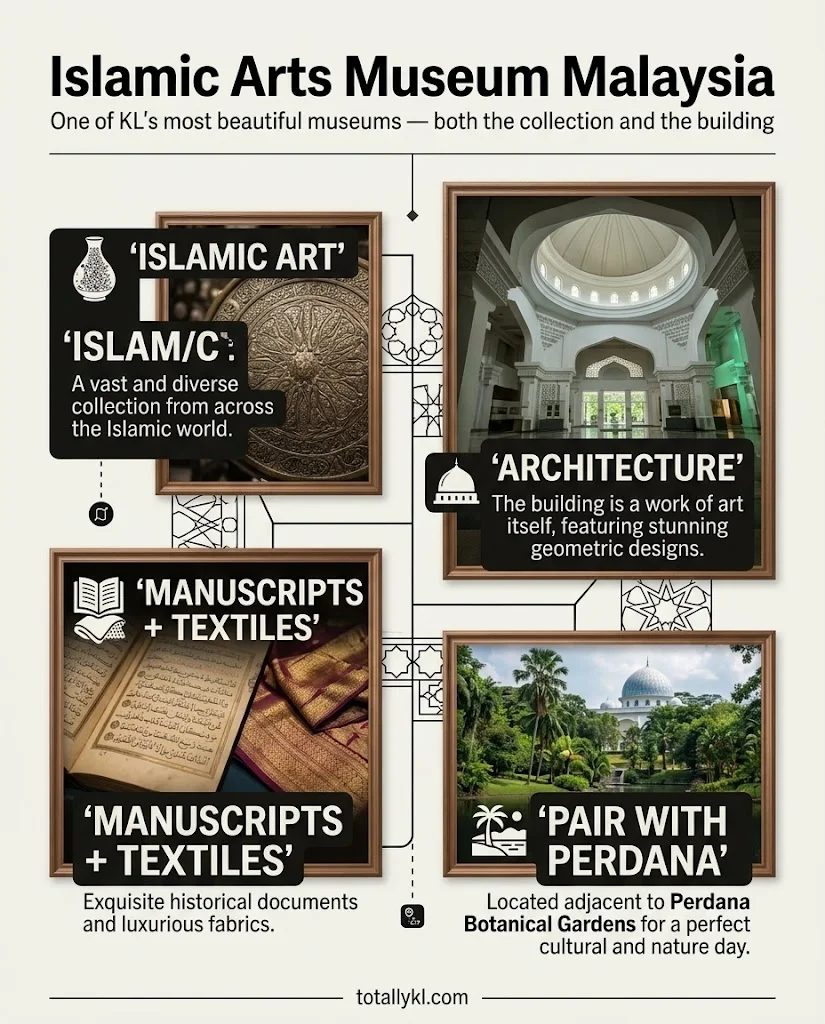
Why this museum deserves more than “rainy-day backup” status
The Islamic Arts Museum Malaysia (IAMM) is one of Kuala Lumpur's most substantial cultural institutions, with a permanent collection organised across 12 galleries covering more than a millennium of art, design and material culture from the Islamic world. It is close to the National Mosque and Perdana Botanical Gardens, which makes it easy to combine with a heritage or park day, but the collection is strong enough to be the main reason for coming to this part of the city.
The museum is especially good at showing that “Islamic art” is not one visual style. Galleries move between the Malay world, China, India and wider regions, alongside manuscripts, metalwork, ceramics, textiles, jewellery, arms and armour, woodwork, coins and seals. Visitors who arrive expecting only calligraphy and mosque models usually discover a much broader story.
Current opening hours and tickets
The official IAMM visitor page currently lists gallery hours of 9:30 AM to 6:00 PM daily, with the museum closed on Hari Raya Aidilfitri and Hari Raya Aidiladha. During Ramadan, the museum publishes reduced hours, so check the current visitor page if your trip falls in that period.
Current general admission is published by the museum rather than hard-coded permanently here because rates can change. As of the museum's current 2026 visitor information, adult admission is RM20 with reduced categories for students and some senior visitors, and children under six enter free. Tickets can be bought at the Customer Service counter; general visits do not currently require advance booking.
Check IAMM's own visitor page on the day for holiday, Ramadan or exhibition changes. The museum also publishes current exhibitions and programmes separately, so a temporary show can be a good reason to allow extra time.
The 12 permanent galleries
IAMM's permanent collection is arranged thematically rather than as one long chronological march. The official museum site currently lists galleries devoted to Architecture, Arms & Armour, Ceramics, China, Coin & Seal, India, Jewellery, Living With Wood, the Malay World, Metalwork, Qur'an & Manuscript and Textile.
That structure makes the museum easy to customise. Architecture fans can spend time with models and building traditions; textile and jewellery visitors can compare materials across regions; manuscript lovers can focus on calligraphy and book arts. You do not need to absorb all 12 galleries at the same depth for the visit to feel worthwhile.
Start with the Architecture Gallery if you feel overwhelmed
The Architecture Gallery is a useful orientation point because models make regional differences immediately visible. It gives visitors who do not arrive with specialist art-history knowledge a concrete way into ideas that later reappear in ornament, geometry and religious design elsewhere in the collection.
From there, choose two or three themes that genuinely interest you. Trying to read every label in every gallery is a reliable way to turn an excellent museum into a tiring one.
The Malay World gallery adds local context
For a Kuala Lumpur visitor, the Malay World gallery is particularly valuable because it connects the broader Islamic collection to Southeast Asia rather than presenting Islamic art only through the Middle East. That regional perspective helps explain how belief, trade, court culture, craft traditions and local materials shaped distinctly Southeast Asian forms.
If you are also visiting mosques, museums or historic districts elsewhere in Malaysia, this gallery can make later architectural and decorative details easier to notice.
Qur'an, manuscript and calligraphy collections
The Qur'an & Manuscript gallery is one of the museum's strongest reminders that a sacred text can also sit within a deep tradition of paper, ink, illumination, binding and calligraphic craft. The point is not simply to compare “beautiful old books”; regional scripts and decorative traditions reflect different centres of scholarship and artistic production.
Visitors unfamiliar with Arabic calligraphy do not need specialist knowledge to enjoy it. Look at scale, page structure, colour, margins and repeated geometric or vegetal motifs, then use the labels to understand where and when the object was made.
Textiles, jewellery and material detail
Textile and jewellery galleries reward slower looking because their impact comes from technique as much as size. Embroidery, weaving, metal settings and surface pattern can be easy to rush past after a dramatic architectural model or manuscript. Give yourself enough time to notice construction and material rather than treating decorative arts as filler between “major” objects.
The museum's current special-exhibition programme can also deepen these themes. IAMM's official What's On page lists temporary exhibitions and education events, so check what overlaps your dates rather than assuming the permanent collection is the whole visit.
How long should you allow?
About 90 minutes is a sensible minimum for a selective first visit. Two to three hours is better if art, design, manuscripts or architecture are important to you. A museum enthusiast can stay longer, especially with a temporary exhibition, restaurant break or museum shop.
Do not schedule the museum as a 45-minute gap between the National Mosque and a train. The collection is larger than the building's calm atmosphere initially suggests, and the value comes from slowing down enough to compare objects across regions.
Getting there by rail
The museum's official visitor guidance lists Kuala Lumpur station (KTM Komuter/ETS) at roughly a five-minute walk past Masjid Negara and Pasar Seni (LRT/MRT) at roughly a ten-minute walk. Muzium Negara MRT is farther on foot, while KL Sentral is practical for a short taxi or e-hailing connection.
Those walking times are useful estimates, but Kuala Lumpur heat and road crossings can make them feel longer. If you are arriving with children, older relatives or in heavy rain, an e-hailing drop directly at the museum's front entrance can be worth the small saving in effort.
Pair it with the National Mosque
IAMM immediately neighbours Masjid Negara, the National Mosque, making the two an obvious cultural pairing. The practical order depends on mosque visitor hours and prayer times: check the mosque's current non-Muslim visiting arrangements first, then fit the museum around them because IAMM's gallery hours are longer and more predictable.
Dress and behaviour rules differ between a functioning mosque and a museum. Treat the mosque as an active religious site, follow staff directions, and keep the museum visit separate rather than assuming one ticket or visitor code covers both.
Pair it with Perdana Botanical Gardens
Perdana Botanical Gardens is the natural outdoor companion. A good tropical-weather strategy is gardens earlier in the morning, museum through the hotter midday period, then another nearby heritage stop later.
The wider area also includes KL Bird Park, the National Planetarium, Royal Malaysia Police Museum and other attractions. Avoid trying to “do the whole Lake Gardens district” in one day just because the pins look close. Pick the museum plus one or two nearby priorities.
Accessibility
IAMM publishes unusually useful accessibility information. The main Jalan Lembah Perdana entrance is step-free with a wide automatic door, lifts connect the lobby and gallery floors, a ramp links upper levels, wheelchair-friendly toilets are available, and benches are placed throughout the permanent galleries.
That makes IAMM one of Kuala Lumpur's easier major cultural attractions for visitors who need a slower or step-free visit. If you have a specific access requirement, confirm current arrangements directly with the museum before travel rather than relying on a general accessibility label.
Families and children
The museum is not designed as a theme park, but it can work well for families who choose a focused route. Architecture models, armour, jewellery and pattern-rich objects give children obvious visual hooks, while the museum also runs education programmes and maintains a Children's Library.
Keep the visit shorter for younger children and use the gardens or nearby attractions to break up the day. The museum's calm environment is an advantage when everyone needs relief from heat, rain or a packed sightseeing schedule.
MOZA Restaurant and the museum shop
MOZA Restaurant & Café is inside the museum complex and gives you a convenient pause without leaving the site. IAMM currently publishes separate restaurant hours and a last-call time, so check the official visitor page if lunch is part of your plan.
The museum shop is also better than a generic souvenir stop for visitors interested in Islamic art, design and research because it carries IAMM publications as well as museum merchandise. If a particular catalogue or exhibition book matters, browse before the end of the day rather than assuming every title will remain in stock.
Photography and museum etiquette
Follow the museum's current signage and staff instructions for photography, especially around temporary exhibitions or sensitive objects. Even when photography is permitted, avoid flash if prohibited, do not block narrow gallery routes, and let other visitors spend time with displays without turning every object into a photo queue.
Food and drinks belong in designated areas rather than galleries. Lockers are available near the lobby through Customer Service, which is useful if you arrive with a larger bag during a travel day.
A practical two-hour route
- Architecture Gallery: start with an easy visual overview.
- Malay World: add Southeast Asian context while you are in Kuala Lumpur.
- Qur'an & Manuscript: slow down for book arts and calligraphy.
- Choose two material galleries: textile, jewellery, ceramics, metalwork, wood or arms and armour depending on interest.
- Temporary exhibition: include it if the current programme appeals.
- Finish with the shop or MOZA: then continue to the National Mosque or gardens.
Common mistakes
- Treating IAMM as a tiny specialist museum. Twelve galleries need real time.
- Going only because it is raining. The permanent collection is a first-rate cultural stop in its own right.
- Relying on old admission prices or holiday hours. Use IAMM's current visitor page.
- Walking from a station without accounting for heat. The distance is manageable, but conditions matter.
- Trying to pair every nearby attraction. Museum + mosque or museum + gardens is a better-paced half day.
Bottom line
Islamic Arts Museum Malaysia is one of the easiest Kuala Lumpur recommendations to make because it works on several levels: serious collection, beautiful indoor environment, strong local and international context, practical accessibility and an excellent location beside the National Mosque and Lake Gardens area.
Allow at least 90 minutes, choose the galleries that match your interests, and verify current hours, admission and exhibitions on the official IAMM site. If you enjoy art or architecture, give it two or three hours rather than treating it as an add-on.