

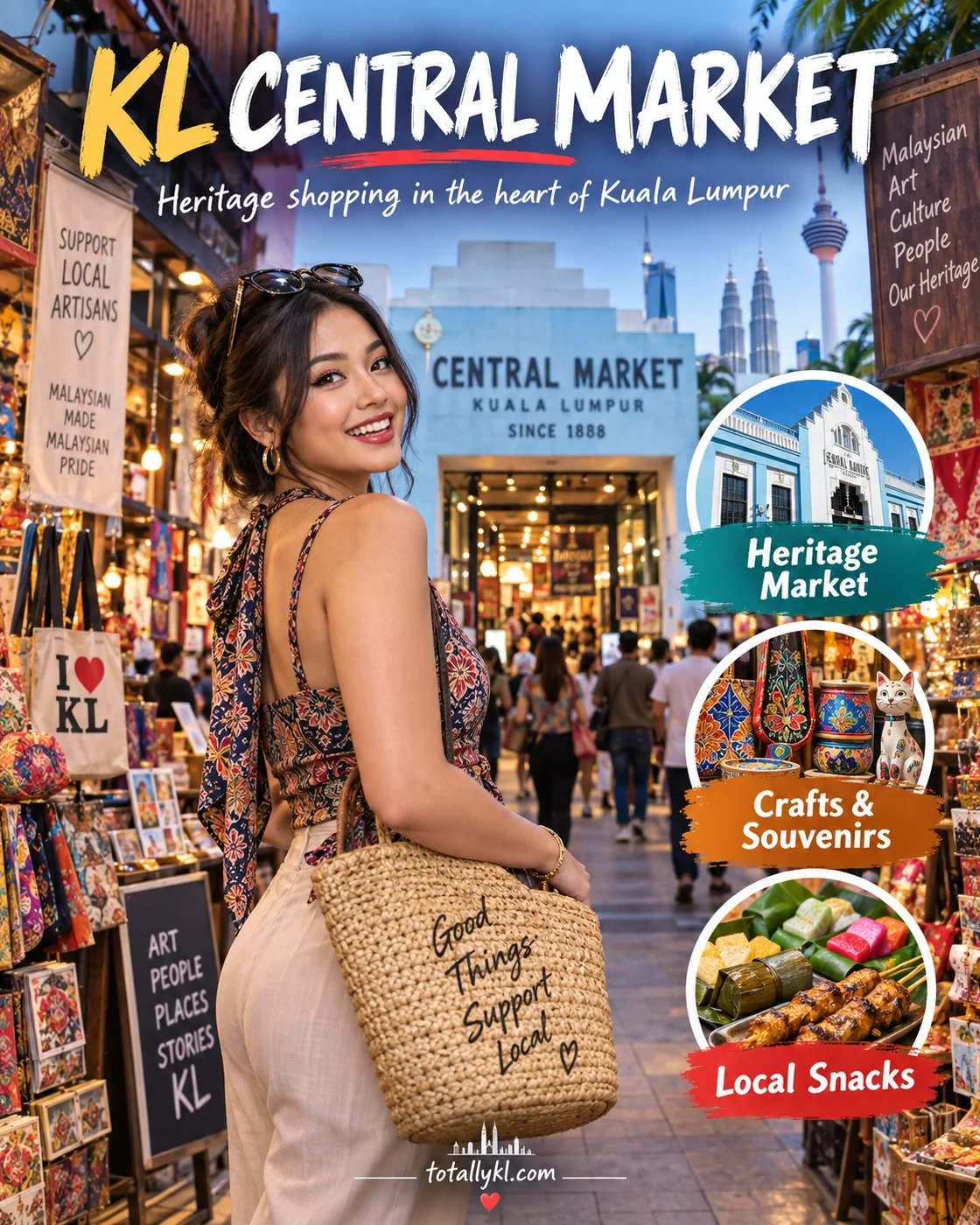
Why Central Market is worth a stop
Central Market sits in the old-city core between Chinatown and the Merdeka area, making it unusually easy to add to an itinerary. The official market describes itself as a centre for Malaysian culture, art and craft, while Tourism Malaysia highlights batik, handicrafts, textiles, paintings and handmade goods. You do not need to be a dedicated shopper to enjoy it.
The strongest reason to visit is the combination: heritage building, air-conditioned browsing, locally themed gifts, art spaces and a location that links naturally with several of KL's best walking districts.
A market that started in 1888
Central Market began as a wet market in 1888. The present heritage identity grew from that commercial history, and the building later evolved into the arts-and-crafts destination visitors know today. Tourism Malaysia describes its restored Art Deco facade as part of the experience rather than simply a shell around souvenir shops.
You do not need a detailed architectural tour to appreciate it. Look up at the facade before entering, then notice how different the calm interior feels from nearby Petaling Street.
Current opening hours and admission
The official Central Market website currently lists opening hours of 10am to 10pm daily. Browsing the main market does not require an admission ticket. Individual workshops, attractions, exhibitions or special events may have their own schedules or charges.
Hours can change around special events or operational needs, so re-check the official Central Market website if your itinerary depends on a late arrival.
What you will find inside
Expect a curated visitor market rather than a bargain produce market. Tourism Malaysia specifically highlights handicrafts, songket, batik clothing, paintings and handmade items. You will also see jewellery, homewares, prints, decorative pieces, snacks and lightweight souvenirs aimed at travellers.
Quality and originality vary from shop to shop, so the best approach is to browse first. If you want a meaningful Malaysian-made item rather than a generic fridge magnet, spend time comparing materials, workmanship and provenance.
Batik and textiles
Batik is one of the most useful categories to explore because you can find everything from small accessories to fabric, shirts, scarves and decorative pieces. Patterns range from traditional motifs to contemporary interpretations.
If the making process matters to you, ask whether an item is hand-drawn, block-printed, screen-printed or mass-produced. Those are different products and should not be evaluated only by price. Our Malaysian arts and crafts guide gives more background before you shop.
Crafts, art and gifts
Woodwork, pewter, ceramics, woven products, prints and decorative objects make Central Market useful when you want a gift that feels connected to Malaysia but is still practical to carry home. Flat textiles and prints are obviously easier luggage than fragile ceramics or heavy metalwork.
For higher-value pieces, ask what the item is made from, where it was produced and how it should be packed. If authenticity or artist attribution matters, buy from a seller who can explain the work rather than relying on assumptions.
Central Market Annexe and Art Lane
The market's cultural role extends beyond the main retail hall. Tourism Malaysia notes galleries in the Central Market Annexe and an Art Lane with studios featuring local artists. Exhibitions and tenants can change, so treat the exact lineup as something to discover on the day rather than a permanent checklist.
If you enjoy contemporary art more than souvenir shopping, allow time for the Annexe instead of racing through the main building and leaving.
Events change the feel of the visit
Central Market runs a busy event calendar rather than one fixed weekly performance schedule. Its official 2026 listings include craft markets, book events and Merdeka-season programmes, often using the wider market precinct. That means a visit on one weekend can feel quite different from an ordinary weekday.
Check the official events calendar shortly before you go. Do not rely on an old claim that one particular performance happens every Saturday forever.
Kasturi Walk
Kasturi Walk runs beside the main market and adds a more open-air browsing element, with smaller retail and food activity. It is useful if you want a quick snack or a less polished market atmosphere before or after the indoor section.
Because outdoor stalls and event setups can vary, treat Kasturi Walk as part of the precinct rather than a list of guaranteed vendors.
Is Central Market expensive?
It is a tourist-oriented heritage market in a prime central location, so do not assume every item is the cheapest version available in Kuala Lumpur. The value is convenience, presentation, variety and the ability to compare many Malaysian-themed goods under one roof.
For a common souvenir, compare a few shops before buying. For a handmade or artist-produced piece, evaluate the work rather than treating every purchase as a haggling contest.
Do you need to bargain?
Many shops operate more like small retail stores than informal street stalls, and fixed prices are common. If a seller is open to negotiation on a larger purchase, keep it polite. Aggressive bargaining over a low-cost handmade item is unlikely to improve your holiday.
For multiple items from the same shop, asking whether there is a bundle price is a straightforward way to test flexibility without making the interaction awkward.
Cash, cards and payment
Payment options vary by seller. Larger shops may accept cards or QR payments, but carrying some Malaysian ringgit gives you a fallback for smaller purchases and nearby food. Do not assume every vendor uses the same payment system.
For cash, exchange and card guidance, see our KL money and currency guide.
How much time to allow
A quick browser can see the main hall in 30–45 minutes. Give it around 60–90 minutes if you actually want to compare crafts, visit Art Lane or the Annexe, stop for food or catch an event. Serious shoppers can stay much longer without trying.
The key is not to over-allocate time simply because it is famous. Central Market works best as one component of an old-city half-day.
Best time of day
Earlier in the day tends to make browsing easier if your priority is shopping and photography. Late afternoon or evening can be livelier when an event is running and also flows naturally into Chinatown food or the city centre after dark.
Because the market is indoors, it is also a useful heat or rain break between outdoor sights. That makes it a good itinerary buffer when KL weather refuses to cooperate.
Getting there
The market is on Jalan Hang Kasturi in central Kuala Lumpur and is well served by public transport. Pasar Seni is the obvious nearby rail stop, with LRT and MRT connections making it easy to reach from many visitor areas.
See our getting around KL guide for the wider network. Driving purely to visit the market usually adds parking and city-centre traffic to a place that is already easy by rail.
Pair it with Chinatown and Petaling Street
This is the natural combination. Walk from Central Market toward Chinatown and Petaling Street, adding temples, food and street browsing without another transport leg. Tourism Malaysia likewise presents the two areas as close neighbours.
If you start in the morning, Central Market gives you an indoor pause before the busier food and market energy of Chinatown. If you start later, reverse the order and finish with dinner nearby.
Pair it with Merdeka Square and the historic core
Another strong route links Central Market with Masjid Jamek, the River of Life area and Merdeka Square. The distances are manageable for many visitors, though heat and rain can make a short map distance feel longer.
Cluster these sights into one old-city block rather than making separate trips from KLCC or Bukit Bintang.
Families and children
Central Market is easier with children than many outdoor markets because the main building is contained and provides relief from sun and rain. The challenge is shopping patience rather than logistics.
Give children something specific to look for — a batik pattern, postcard, snack or small craft — and the visit becomes more engaging than dragging them past dozens of similar souvenir displays.
Accessibility and mobility
The central location and indoor layout can suit travellers who need a lower-intensity stop, but individual shop thresholds, crowded aisles, event layouts and access to every part of the Annexe can vary. If step-free access or accessible toilets are essential, check current arrangements with Central Market before relying on assumptions.
Going outside peak event periods also gives wheelchair and mobility-aid users more room to browse comfortably.
What not to do
- Do not buy the first “Malaysian craft” you see if origin and workmanship matter to you.
- Do not assume every seller expects aggressive bargaining.
- Do not schedule Central Market as a standalone cross-city mission when Chinatown and Merdeka are beside it.
- Do not rely on old event timetables; the official calendar changes throughout the year.
- Do not overfill luggage with heavy or fragile souvenirs without asking how they will be packed.
Use Central Market as the indoor anchor of an old-KL walking block: browse crafts, cross into Chinatown, then continue toward Merdeka or stay for dinner. The location is more valuable than treating the market as an isolated attraction.