
Start with the realistic risk picture
Kuala Lumpur is a huge, busy capital rather than a resort town, and the most useful safety mindset is ordinary city awareness rather than fear. Crowded rail stations, shopping streets, nightlife districts and road crossings deserve more attention than dramatic worst-case scenarios. Keep valuables controlled, avoid flashing large amounts of cash, and make deliberate transport choices after dark.
Save 999 before you need it
Malaysia's government lists 999 as the national emergency line connecting police, fire and rescue, health, civil defence and maritime emergency services. The current NG MERS 999 system is intended for genuine emergencies. Save your accommodation name and address in your phone as well, so you can give responders or a driver a precise destination.
Official reference: Malaysia Government — MERS 999 emergency line.
Phones, bags and crowded places
Petty theft is the risk most travellers can reduce with simple habits. Keep a cross-body bag zipped and positioned away from the road edge, especially while walking beside traffic. Do not leave a phone on a café table beside an open walkway. On crowded trains and escalators, move your wallet or phone out of an exposed back pocket.
Carry only the cash you expect to use that day and keep a second card separately. A digital copy of your passport and travel-insurance details is useful, but store it securely rather than in a publicly accessible photo album or shared folder.
Traffic is a bigger practical hazard than many visitors expect
KL is not consistently pedestrian-friendly. Multi-lane roads, slip lanes, motorcycles and long junction cycles can make a short map distance awkward on foot. Use pedestrian crossings, footbridges and station links rather than following locals through moving traffic. If a route on your map looks unpleasant or unsafe, a short rail hop or booked ride is often the sensible option.
Late-night transport
After a late meal or night out, use a booked ride with a recorded driver and vehicle rather than accepting an unsolicited lift. Confirm the registration before getting in and use the app's trip-sharing tools if you want someone else to know your route. Around Bukit Bintang, Changkat and major malls, walk to a well-lit pickup point instead of waiting in a dark side lane.
Solo women travellers
Women travel alone in KL every day, and solo dining, rail travel and hotel stays are unremarkable. The useful precautions are the same ones that make any large city easier: choose accommodation with a straightforward route back from the nearest station, avoid isolated shortcuts late at night, keep your drink with you in nightlife venues and leave any situation that feels pushy or uncomfortable.
Clothing rules are context-specific. Normal city clothing is fine in most of KL, while mosques and some religious sites require more coverage. Carrying a light layer makes those visits easier without treating the whole city as if it has one dress code.
Scams and unwanted approaches
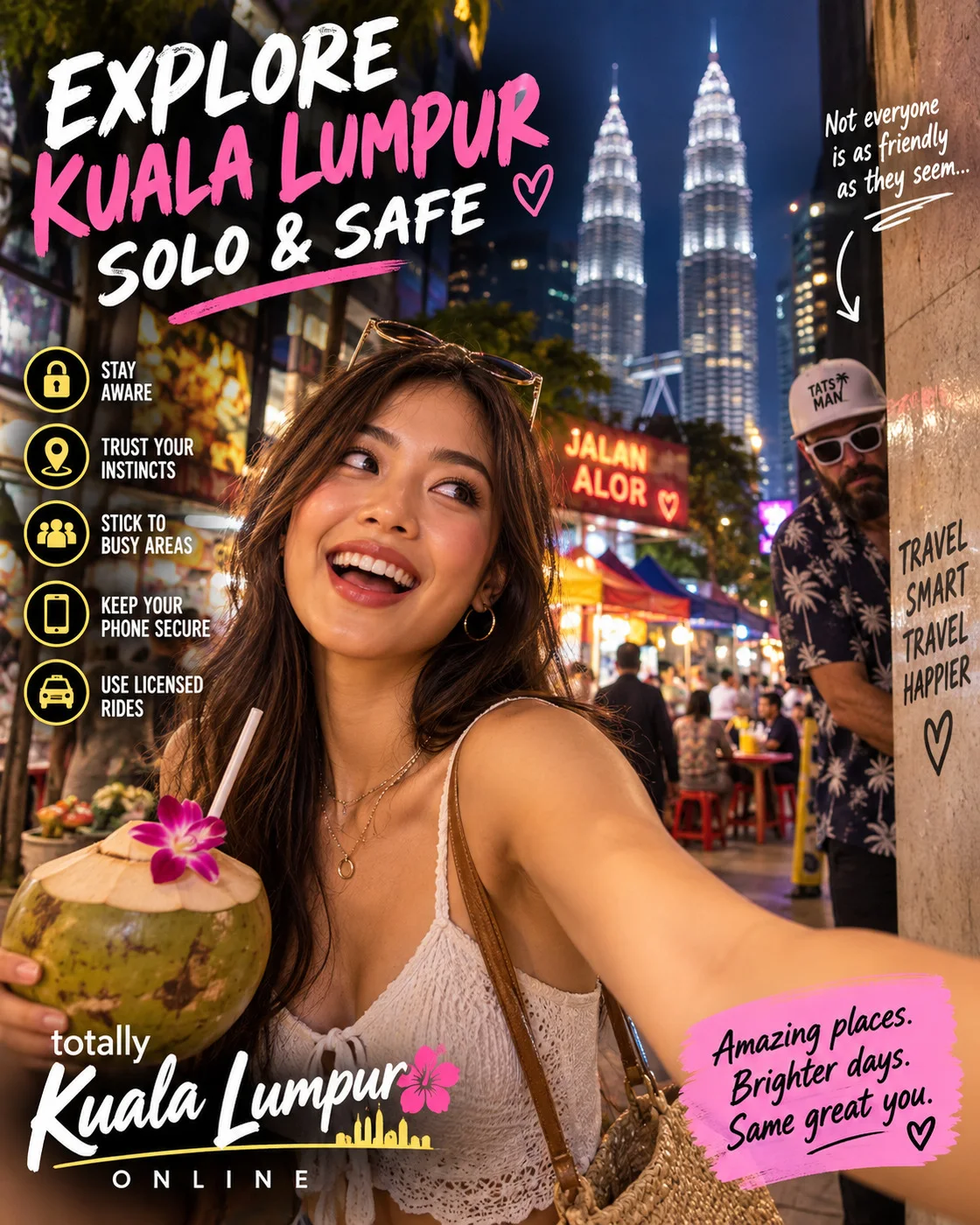
Be cautious when a stranger creates urgency around money, transport, tickets, gambling, jewellery or an unexpectedly complicated 'problem' that only they can solve. Pause, verify independently and move to an official counter or staffed venue. For a fuller checklist, see our KL scams and tourist traps guide.
Nightlife without unnecessary risk
KL's nightlife ranges from rooftop bars to busy pub streets and late-night food districts. Keep control of your own drink, know how you are getting home before you start drinking, and do not carry your passport on a casual night out unless a venue specifically requires identification and you have no safer accepted alternative.
Heat, storms and long sightseeing days
Safety is also about avoiding preventable exhaustion. KL's heat and humidity can make a walking-heavy itinerary much harder than the distance suggests. Drink regularly, use air-conditioned stops strategically, and do not treat a thunderstorm as a minor inconvenience if lightning and intense rain are close. Build flexibility into outdoor plans rather than racing across the city to preserve a timetable.
If something does go wrong
- Move somewhere safe and staffed if possible.
- For a genuine emergency, call 999.
- Freeze lost bank cards immediately through your banking app or issuer.
- Ask your hotel or accommodation host for practical local help, including the nearest appropriate police station or clinic.
- Contact your travel insurer early if medical treatment, theft documentation or trip disruption may become a claim.
Before leaving your hotel each morning, screenshot the day's key addresses and keep enough battery for navigation and a booked ride home. That tiny routine solves a surprising number of avoidable problems.